
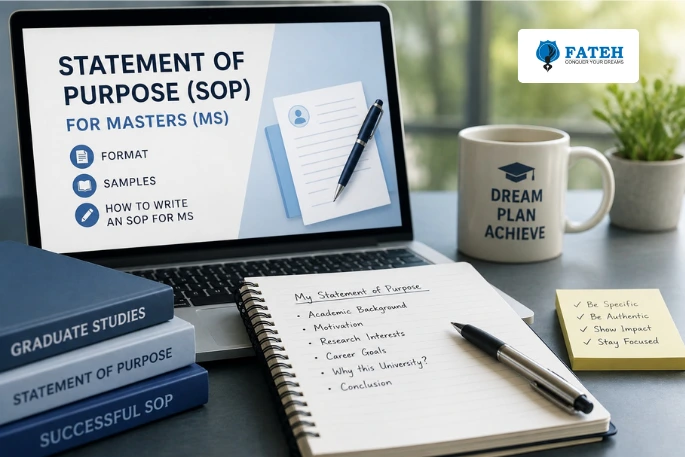
Introduction
Every year, university admissions teams read thousands of applications from students with impressive grades, competitive test scores, and relevant work experience. Yet, many of these applications begin to blur together because numbers alone rarely tell the complete story of a profile. What often makes an admissions officer pause is a well-written Statement of Purpose for Masters; one that clearly explains not just what an applicant has achieved, but why they have chosen a particular path and where they hope it will lead.
A Statement of Purpose is your opportunity to connect the dots between your academic journey, professional experiences, and future ambitions. It helps the admissions committee understand the person behind the transcripts and certificates, offering insights that no resume or mark sheet can ever provide.
Now whether you are applying for an MSc in Data Science, an MBA, a Master’s in Public Health, or any other postgraduate programme, learning how to write a compelling statement of purpose for masters degree can significantly influence the approval of your application. In this guide, we will walk you through the ideal SOP format, what to include, practical writing tips, common mistakes to avoid, and how tools like ChatGPT can support your writing process without compromising authenticity.
What Is a Statement of Purpose for Masters?
A Statement of Purpose for Masters, commonly referred to as an SOP for Masters, is a formal essay submitted as part of your university application. It reflects on your educational journey, professional experiences, reasons for choosing a particular country and university, career aspirations, and why you believe your background aligns with the course.
Simply put, if someone asks, what is statement of purpose for masters, the answer is this: it is a document that explains your motivation, qualifications, and future goals in a structured and convincing manner.
Unlike transcripts or recommendation letters, an SOP gives context to your achievements, explains your decisions, and demonstrates that your choice of programme is backed by careful research and genuine intent.
Statement of Purpose vs Personal Statement for Masters
The terms Statement of Purpose and personal statement for masters are often used interchangeably, but they don’t necessarily mean exactly the same thing.
A Statement of Purpose is generally more academic and career oriented and focuses on your academic credentials, practical exposure, research interests, short-term and long-term ambitions, and reasons for choosing a specific country and university. Whereas a personal statement emphasises personal experiences, motivations, values, and the journey that shaped your academic interests. Some universities, particularly in the UK, prefer the term personal statement, while others particularly ask for an SOP. In many cases, however, the expectations overlap considerably.
The safest approach is to review the university’s application guidelines carefully. If no distinction is mentioned, you can assume the two terms refer to a similar document. However, if separate instructions are provided, tailor your content accordingly rather than submitting the same essay for both.
What to Include in a Statement of Purpose for Masters
A compelling SOP isn’t built around impressive vocabulary or dramatic storytelling, but it is a natural chronology of educational and professional events in a student’s journey that helps the admissions committee understand why you’re ready for postgraduate study.
Here are the key elements every statement of purpose for masters should include:
- Academic Background: Begin by outlining your educational journey. Mention your undergraduate degree, relevant coursework, research projects, dissertations, academic achievements, or certifications that have prepared you for the programme you’re applying to.
- Professional Experience: Discuss your responsibilities, key projects, technical skills, leadership experiences, or industry exposure. Even if you don’t have full-time work experience, internships, freelance projects, research assistantships, or volunteering can demonstrate valuable skills and initiative.
- Gap Years, if application: In this section, you need to provide a brief justification if your profile has any academic or professional breaks.
- Why This Country: Mention course relevant aspects such as research centres, laboratory facilities, industry collaborations, teaching methodology, or opportunities that genuinely interest you.
- Why This Course and University: Explain what attracted you to this particular programme, whether it’s the curriculum, specialised modules, practical learning opportunities, research focus, or industry relevance.
- Career Goals: Explain the role you hope to pursue after graduation and how this master’s degree bridges the gap between your current profile and future ambitions.
- Personal Qualities: In conclusion, highlight qualities that make you a strong postgraduate candidate. This could include analytical thinking, leadership, curiosity, adaptability, or problem-solving skills.
How to Write a Statement of Purpose for Masters Degree
Many applicants assume a successful SOP is built around impressive achievements. But that is not completely true! Admissions committees are looking for something much simpler: a clear explanation of why you are applying, how your experiences have prepared you, and what you plan to achieve after graduation. If you are wondering how to write a statement of purpose for masters degree, think of it as building a logical narrative rather than just writing an autobiography.
- Understand What the University Is Looking For
Before you write your first sentence, spend time researching the programme, and read the course modules, faculty profiles, research opportunities, and the university’s mission.
- Reflect on Your Academic and Professional Journey
- What sparked your interest in this field?
- Which academic experiences strengthened that interest?
- Has any internship, project, or job influenced your career goals?
- Why do you need a master’s degree now?
- Build a Clear Narrative
Now your academic background should blend with your professional experiences. Those experiences should explain why you want to pursue a master’s degree, which should naturally connect to your future career goals. When your experiences support each other, your application appears focused and well thought out. - Be Specific Instead of Generic
Instead of writing:“I am passionate about Artificial Intelligence.”
Explain why.
For example:
“While developing a machine learning model during my undergraduate capstone project, I became interested in how predictive analytics could improve clinical decision-making. That experience motivated me to pursue advanced study in Artificial Intelligence.”
- Tailor Every SOP
Even if you are applying to multiple universities, avoid sending the same document everywhere. Mention modules, laboratories, faculty members, research centres, or industry collaborations that genuinely interest you. - Keep Your Future Goals Realistic
Admissions committees appreciate applicants who have a clear direction.Instead of vague ambitions like “I want to become successful,” explain:
- the role you hope to pursue after graduation,
- the industry you would like to work in,
- and how this master’s degree helps you get there.
SOP Format for Masters
While every university has its own requirements, most follow a broadly similar structure like:
| Section | Inclusion |
|---|---|
| Introduction | An opening paragraph that highlights how your interest developed in the field. |
| Academic Background | Relevant degrees, projects, research, or certifications. |
| Professional Experience | Any work experience or internships related to the course. |
| Gap Years, if any | A brief justification if your profile has any academic or professional gaps. |
| Why This Country | Explain how pursuing the particular programme in this country supports your academic endeavours. |
| Why This Course and University | Mention of relevant modules, dissertation, university ranking, faculty and teaching methodologies. |
| Career Aspirations | Short term and long term goals that align with your chosen programme. |
| Conclusion | Reiterating why you are a suitable candidate for this academic pursuit. |
Most universities expect an SOP for Masters to be between 800 and 1,000 words, although some may specify shorter or longer limits. Therefore, it is always advisable to check the university’s official guidelines before submitting your final application.
Formatting Guidelines
A clean, professional presentation is just as important as the content itself.
Most applicants should follow these general formatting practices:
- Font: Times New Roman, or Calibri
- Font size: 11–12 pt
- Line spacing: 1.5 or double spacing (if specified)
- Margins: Standard 1-inch margins
- Paragraphs: Clearly separated with logical transitions
How to Start a Statement of Purpose for MS
For many applicants, writing the first paragraph feels like the hardest part. That is because they assume it has to sound extraordinary, but does it really? Let’s see!
Start with a Defining Academic Experience: It could be a university project, research paper, or laboratory assignment that changed the way you looked at your subject.
Begin with a Professional Insight: If you have worked in your field, use an experience that revealed a gap in your knowledge. For example, an engineer might realise they need advanced expertise in renewable energy systems, while a healthcare professional may recognise the growing importance of health informatics.
Introduce a Problem You Want to Solve: Some of the most realistic SOPs begin with a real-world challenge that genuinely interests the applicant. Whether it’s improving urban infrastructure, developing sustainable business solutions, advancing pharmaceutical research, or applying artificial intelligence in healthcare, explain how it leads into your academic goals.
Statement of Purpose for Masters Samples by Study Goal
Reading SOP samples for Masters can help you understand the tone, structure, and flow expected by universities. However, remember that these samples are only meant for inspiration, as admissions committees can quickly identify copied or heavily borrowed content, which can negatively impact your application.
Sample 1: Engineering & Technology
During my undergraduate studies in Mechanical Engineering, I became increasingly interested in sustainable manufacturing systems. While working on my final-year project on energy-efficient production methods, I realised that technological innovation alone is not enough without advanced analytical and research skills. Pursuing a Master’s in Advanced Manufacturing will allow me to build expertise in automation, smart production systems, and industrial optimisation while preparing me for a career in modern manufacturing.
Sample 2: Business & Management
Working as a Business Analyst exposed me to strategic decision-making, consumer behaviour, and market expansion challenges. While I developed strong analytical skills through industry projects, I recognised the need for a broader understanding of international business strategy and organisational leadership.
Sample 3: Healthcare & Life Sciences
My experience as a clinical pharmacist taught me that modern healthcare depends not only on medical knowledge but also on effective regulation, research, and patient safety. Working with regulatory documentation inspired me to specialise in Pharmaceutical Regulatory Affairs, enabling me to contribute to bringing safe and effective medicines to global markets.
Notice how each example focuses on three key elements:
- A defining academic or professional experience
- The knowledge gap that motivated postgraduate study
- How the master’s programme supports future career goals
Regardless of your discipline, your SOP should demonstrate progression rather than simply listing accomplishments.
Tips for Writing an Effective Statement of Purpose for Masters
Let’s look at some practical tips that can strengthen your application.
Starting Early
Give yourself enough time to brainstorm, draft, revise, and refine your ideas. Starting early also allows you to seek feedback without rushing the process.
Research Before You Write
Understand the university, course curriculum, faculty expertise, research opportunities, and industry collaborations.
Focus on Relevance
Every paragraph should answer an important question about your application. If a detail does not strengthen your candidacy or explain your motivation, consider leaving it out.
Show Growth
Highlight how your projects, internships, or work experience shaped your interests and prepared you for postgraduate study.
Maintain a Professional Yet Conversational Tone
Your SOP should sound like an educated, thoughtful individual, not like a marketing brochure. So, avoid exaggerated claims, dramatic storytelling, or unnecessarily complex vocabulary.
Support Claims with Real Examples
Rather than writing, “I have strong leadership skills,” explain a project where you led a team, solved a problem, or managed responsibilities successfully.
Tailor Every Application
Personalise each draft by referring to programme-specific modules, faculty, or opportunities.
Proofread Carefully
Review your SOP multiple times and ask someone you trust to proofread it before submission.
Common Statement of Purpose Mistakes That Hurt Masters Applications
Even the most suitable applications can land in rejection by making these mistakes in their SOP:
Writing Generic Content
Statements such as “I have always been passionate about learning” or “This university is one of the best in the world” appear in thousands of applications every year.
Repeating Your Resume
Your resume already lists your achievements, so, your SOP should explain their significance and how they influenced your academic or professional decisions.
Ignoring the University’s Requirements
Some universities specify word limits, formatting instructions, or questions that must be addressed and failing to follow these guidelines reflects poorly on your attention to detail.
Overusing Technical Language
Demonstrating subject knowledge is important but avoid turning your SOP into a research paper.
Copying Online Samples
Reading SOP samples for Masters is helpful but copying them is not. Universities routinely use plagiarism detection software, and duplicated content can lead to immediate rejection.
Using ChatGPT for Your Statement of Purpose Safely
With AI tools becoming increasingly accessible, many students wonder whether they can use ChatGPT while writing their SOP.
The answer is yes, but very responsibly and ethically.
It is true that ChatGPT can be an excellent brainstorming and editing companion. It can help you organise ideas, improve sentence structure, identify grammatical errors, and suggest better transitions. However, it should never replace your own experiences or voice.
Admissions committees are looking for authenticity and an SOP generated entirely by AI often lacks personal insight, includes generic statements, and fails to reflect the applicant’s individual journey.
A better approach is to:
- Create your own first draft.
- Use ChatGPT to improve clarity and readability.
- Verify every suggestion before incorporating it.
- Ensure the final document genuinely reflects your experiences and aspirations.
Final SOP Checklist for Masters Applications
Before submitting your application, go through this checklist to ensure your SOP is complete.
- Connects your academic and professional background with your career goals.
- Demonstrates why you’ve chosen this specific country, university and programme.
- Stays within the prescribed word limit.
- Is free from grammatical and spelling errors.
- Has been tailored specifically for the university.
- Maintains a logical flow from introduction to conclusion.
- Is completely original and plagiarism-free.
Conclusion
A well-crafted Statement of Purpose for Masters is more than just another application document; it is your opportunity to present the thinking, experiences, and ambitions behind your academic profile. Whether you are applying immediately after graduation or after several years of professional experience, investing time in crafting a thoughtful, well-structured SOP can significantly strengthen your application. Focus on authenticity, demonstrate a clear sense of purpose, and tailor every submission to the university you’re applying to.
If you are unsure where to begin or would like expert guidance in refining your SOP, the experienced counsellors at Fateh Education can help you create a personalised Statement of Purpose that reflects your unique journey while meeting university expectations.
FAQs
Start by researching the university and programme thoroughly, followed by structuring your draft around your academic background, professional experience, reasons for choosing the country, course, university, career goals, and why you're a suitable candidate.
A good SOP clearly explains your academic journey, relevant experiences, motivation for choosing the programme, and future career goals. It is tailored to the university, supported by real examples, and written in your own voice rather than copied from online samples.
Most universities expect an SOP for Masters to be between 800 and 1,000 words, typically spread across one to two pages. However, some institutions may specify different word limits, so always follow the university's official guidelines.
SOP stands for Statement of Purpose.
ChatGPT can assist with brainstorming ideas, however, your SOP should always be based on your own experiences, achievements, and goals.
You can begin with an experience, observation, project, or professional insight that naturally explains your interest in the field. Avoid clichés, dictionary definitions, or generic statements.