
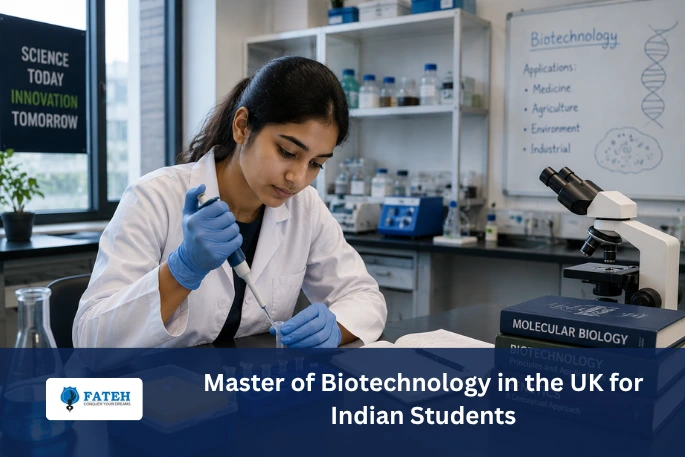
MSc Biotechnology in the UK: An Overview
Renowned across the world for its leading biotech research and innovation, the MSc Biotechnology programme, with its growing global relevance, maintains its position as one of the most sought-after courses, while the UK continues to be a top destination for pursuing it. Moreover, there has been a significant surge in the number of Indian students preferring to study MSc Biotechnology in UK, given the top-notch educational standards and the high employment rate of graduates. On the other hand, the continuous rise in interest among students in pursuing this programme can be attributed to factors such as the Covid-19 pandemic, during which the world looked hopefully and desperately at medical professionals for solutions. While this entails great responsibility, it also highlights the significant power individuals from relevant fields hold in making a difference in enhancing the lived human experiences. This is one of the key benefits of pursuing this discipline. Additionally, pursuing a master`s in Biotechnology in UK, especially at its globally recognised universities, opens the door to higher education abroad while helping you build a meaningful career.
Why Choose the UK for a Master's in Biotechnology
High-Quality Education
Global recognition of degrees from the UK: The country’s academic excellence, cutting-edge research, and strong industry connections inform the curriculum, making the coursework effective and relevant on an international scale. Honoured for its inimitable education standards and top QS World Ranking universities, research-based discoveries, and accreditations, graduates undoubtedly bag the most coveted breaks by multinational employers. Advanced curriculum tailored to industry needs: While the world around us rapidly changes, so do the industries. Acknowledging the importance of staying up to date, universities in the UK deliver curricula that are advanced in the sense that they are not only informed by current trends but are also futuristic in approach, ensuring your learning never becomes obsolete. Access to renowned professors and research opportunities: One of the key benefits of studying this course in the UK is getting access to highly regarded faculty members who are distinguished and celebrated experts in the field. With proven expertise in their field, the professors are excellent at providing mentorship and empowering you to have an advanced perspective towards the field.Industry-Specific Advantages
Emphasis on practical and industry-oriented learning: While the coursework often includes laboratory work, project-based assignments, and case studies, it focuses on providing outstanding practical knowledge, preparing you for actual industry issues, and training you to tackle them. Collaborations with top companies and internship opportunities: This aspect not only helps shape the curriculum and industry demands from graduates but also provides you with opportunities for networking, better access to industry professionals, and, in some cases, even internships. Combined, this expands your employability in the long term.Cultural and Networking Opportunities
Exposure to a diverse cultural environment and networking with peers from across the globe are essential for your transformation in understanding how to traverse global workspaces and studying in the UK offers you exactly that. Since this teaches you to work with diverse individuals, you are vested in better collaborations and opportunities, strengthening your career prospects.Post-Study Work Opportunities
Availability of post-study work visas and pathways to permanent residency: As a graduate of MSc Biotechnology from the UK, the country offers you the opportunity to apply for the Graduate Route Visa, through which you can stay and work in the country for two years after completing your degree. This certainly enhances your international employability and experience while also allowing you to secure long-term job offers, which then helps you become eligible for a Skilled Worker Visa or a Permanent Residency Visa, provided you meet specific requirements.Best Universities for MSc Biotechnology in the UK
Students planning to pursue a master’s in biotechnology can choose from several renowned universities in the UK. Some of the top universities in UK for master’s in Biotechnology are:
University of Manchester
Renowned as a public research university in Manchester, it is a Red Brick, Russell Group university that was established in 2004 and stands 40th globally according to QS World Rankings of 2027. It offers an MSc in Biotechnology and Enterprise, which follows an interdisciplinary approach; therefore, the course is delivered by the Faculty of Biology, Medicine, and Health and the Alliance Manchester Business School
Key features of the course curriculum: It combines advanced biotech studies with business and enterprise training, covering topics such as commercialisation, intellectual property, and synthetic biology. It gives students the opportunity to actively participate in a lab-based research project, applying their knowledge to actual scenarios.
University of Glasgow
It is among the ancient universities of the UK, since it was established in the year 1451. It is also a member of the Russell Group universities and ranks 80th globally as per the QS World Rankings of 2027. Offering an MSc in Biotechnology programme, the university focuses on providing you with advanced practical knowledge in the field of modern biotechnology and molecular genetic technologies.
Key features of course and curriculum: The programme also covers topics relating to environmental biotechnology, synthetic biology, plant engineering, stem cell therapies, and vaccine development.
Queen Mary University of London
Represented by the Russell Group, it is ranked 24th globally and 6th in the UK for quality research. QMUL has been ranked 103 globally and 21st in the UK according to QS World University Rankings. With its MSc in Biotechnology course, it provides state-of-the-art facilities to its students and technologies being used by experienced researchers in this field, i.e., fluorescence microscopy, cryo-electron microscopy, cell-free systems, mass spectrometry and automation.
Key features of course and curriculum and the Unique specializations and facilities available: The program deals with advanced topics ranging from DNA assembly, next-generation sequencing technologies, CRISPR/Cas9 genome editing, cell-free synthetic biology, and directed evolution to bioinformatics and coding.
MSc Biotechnology Course Structure and Specialisations
Core Modules: The exact module names may vary across universities offering Biotechnology courses in the UK. However, these programmes are designed to provide a strong foundation in biotechnology through a combination of theoretical knowledge, practical laboratory training, and research, preparing students for careers in the biotechnology and life sciences sectors.
Overview of subjects covered in the course.
Elective Modules: These focus on providing you specialised tracks and areas of focus. Below are some examples that are offered at some UK institutions for a master’s in biotechnology:
- Stem Cell Biology and Regenerative Medicine
- Industrial Biotechnology
- Pharmaceutical Biotechnology
- Genomics and Bioinformatics
Techniques for Drug Discovery
Eligibility Requirements for MSc Biotechnology in the UK
Academic qualifications: The universities offering Biotechnology masters in the UK require you to have an international equivalent bachelor’s degree in biological sciences or related fields, which include biochemistry, biotechnology, cell biology, genetics, life sciences, microbiology, and molecular biology. Moreover, certain institutions even allow students from a chemistry or chemical engineering background, but you must have completed modules in biological and molecular science to qualify for this course.
Language proficiency: On average, universities generally require international applicants to have an overall score of IELTS 6.5, with each component scoring 6.0 and above. At the same time, students appearing for TOEFL are required to have an overall score of 90, with at least a 21 score in all four components. However, to get a more accurate and university-specific score requirement, it is always best to check the official website.
Application Process for MSc Biotechnology in the UK
Step-by-step guide to the admission process: When you are beginning the process of MSc Biotechnology in UK universities, it is understandable that at times it might become overwhelming, and you might even feel lost. What helps is to ensure that your application is complete and fulfils all the requirements of the university you are applying to.
Research, selection and online application: To begin with the process, you should always research well about the universities you prefer based on your personal criteria, which can include offered modules, professors delivering the course, research work, campus facilities, QS rankings, etc. Once you have done that, proceed with the online application process.
Submitting relevant documents on time: Once the university asks you to submit your documents, such as academic transcripts, SOP, and LORs, send copies of your original and authorised documents for them to verify, assess, and send you an offer letter accordingly within the announced timeline. Failing to do so may result in a high chance of your application being refused.
Application Fee and Interview: The university requires you to pay an application fee, the amount of which varies according to each institution. Once you reach this stage, in some cases, the university might as well ask you for an interview, which can be held in person or online as part of finalising your candidacy for admission.
Offer Letter, Acceptance and Deposit: Upon successful review of your application, you may receive a conditional or unconditional offer. For unconditional offers, you need to accept the proposal by confirming your place and paying the required fee deposit as advised by the university.
MSc Biotechnology Fees and Cost of Living in the UK
Career Opportunities After an MSc Biotechnology in the UK
Job Opportunities: When you consider studying abroad, it is only normal to also wonder about the roles and industries graduates can work in. Well, pursuing an MS Biotechnology in the UK has got you covered, since you can get an opportunity to work in the medical, chemical materials, environment, food and agriculture, and biofuels fields as a graduate in biotechnology. The average salary packages in such roles start from £19,000 to £24,000, whereas as an experienced professional in this field, you can easily earn between £25,000 and £50,000. Additionally, those who are highly experienced (with ten or more years of experience) earn up to £60,000 with additional responsibilities, which ultimately means a more diverse range of experience in the field.
Further Studies: This course offers you opportunities to pursue advanced degrees or certifications, becoming your gateway for professional and academic upgrades.
MSc Biotechnology in the UK vs Other Study Destinations
How to Choose the Right MSc Biotechnology Program
While selecting the right MSc Biotechnology programme, you must consider your academic background, career aspirations, and long-term career goals. Then, you should shortlist universities based on their reputation, the curriculum and specialisations they offer, industry collaborations, research opportunities, and campus facilities. Then review the curriculum carefully to ensure it aligns with your interests and check if the modules will help you gain advanced knowledge in your chosen field. Along with this, evaluate and compare tuition fees, scholarships, location, programme duration, and placement opportunities. By taking care of these aspects, you can select a programme that will help you achieve your long-term career goals.
Common Mistakes Students Make Before Applying
Below are some common mistakes students should avoid making sure they submit a complete and error-free application.
Not researching the programme : Many students apply without understanding the curriculum, specialisations, or learning outcomes of the programme.
Not researching the university: Focusing only on rankings while overlooking research facilities, faculty expertise, and industry collaborations can be a mistake.
Overlooking entry requirements: Some applicants fail to check the academic qualifications, English language requirements, or other admission criteria before applying.
Submitting a weak SOP: A generic or poorly written personal statement may not effectively showcase your academic background, motivation, and career goals.
Missing the Deadlines: Begin the application process 6-7 months before the intended intake and prepare all the documents.
Ignoring career outcomes: Failing to research graduate employability, internship opportunities, industry exposure, and placement support can impact your long-term career plans.
Not comparing multiple universities: Applying to the first university you find without comparing different programmes, course content, and opportunities may lead to missing a better fit.
Rushing the application: Incomplete applications, missing documents, or errors in the application form can negatively affect your chances of admission.
Conclusion
Pursuing an MSc Biotechnology in UK for Indian students can be a transformative step towards building a successful career in biotechnology, pharmaceuticals, healthcare, research, and related life sciences industries. With globally recognised universities, industry-focused learning, advanced research facilities, and excellent career prospects, the UK continues to be a preferred study destination for international students seeking specialised knowledge and practical experience. It will require careful planning and thorough research into universities, course curriculum, tuition fees, scholarships, accommodation, and career opportunities. Taking the time to compare these factors will help you select a programme that aligns your academic background, interests, and long-term career goals. If you are planning to study biotechnology in the UK and need guidance with choosing the right university, seeking expert advice can help you make a well-informed decision and begin your study abroad journey with confidence.
FAQs
Yes, the UK is considered one of the leading destinations for pursuing an MSc in Biotechnology. It offers one year master`s programme and is home to internationally recognised universities, world-class research facilities, and a strong biotechnology, pharmaceutical, and life sciences industry.
University of Manchester, University of Glasgow, and Queen Mary University London are considered as the leading and most acclaimed universities offering MSc Biotechnology Porgramme.
Students are required to have an international equivalent bachelor’s degree in biological sciences or related fields with English proficiency of IELTS 6.5, with each component scoring 6.0; for TOEFL, students are required to have an overall score of 90, with at least a 21 score in all four components.
The tuition fees for an MSc in Biotechnology in UK typically range from £29,950 to £43,300, depending on the university. In addition to tuition fees, international students should budget for living expenses, which average around £1,483 per month in London and £1,136 per month outside London.
Yes, Indian students can apply to government-funded scholarships, university-specific scholarships, and merit-based or need-based financial aid offered by many UK universities. Scholarship eligibility and award amounts vary depending on the institution, academic performance, and programme. Students are advised to check the official university website for the latest scholarship opportunities and application requirements before applying.