
Introduction
The term “red brick universities” refers to a distinctive group of civic universities established in the United Kingdom in the first decade of the 1900s, which was between 1900 and 1910. These institutions were founded in major industrial cities, serving as hubs of education and innovation during Britain’s industrial expansion.
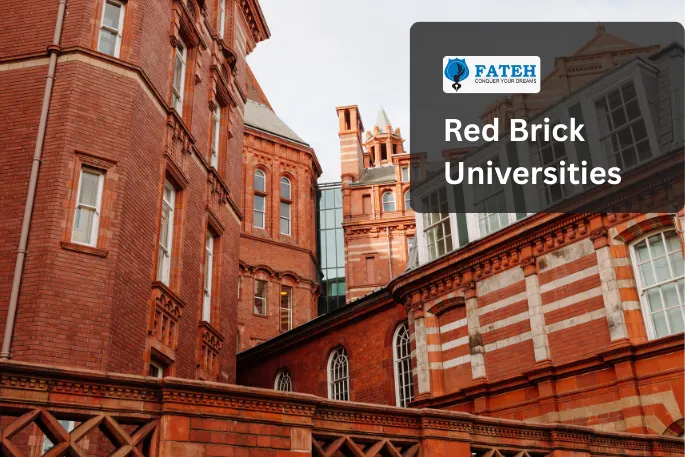
The name “red brick” comes from their characteristic architectural style. Many of these universities were built using red bricks in a Gothic revival or Victorian style, making them visually striking and instantly recognisable. The University of Liverpool’s Victorian-era buildings inspired this design trend, while the University of Birmingham became the first independent university among the original group of six, setting a precedent for civic higher education.
Red brick universities were distinct not only in architecture but also in their mission. They focused on providing practical education and research opportunities to support local industry and communities, differentiating themselves from the older, ancient universities like Oxford and Cambridge. Today, these universities continue to enjoy a reputation for combining strong academic programs with real-world impact.
Complete List of Red Brick Universities in the UK
The six original red brick universities are:
- University of Birmingham – Founded in 1900
- University of Bristol – Founded in 1909
- University of Leeds – Founded in 1904
- University of Liverpool – Founded in 1903
- University of Manchester – Founded in 1903
- University of Sheffield – Founded in 1905
These institutions were the first to break away from purely classical education models, offering courses in engineering, science, medicine, and commerce. Over time, they became prominent research and teaching centres, contributing significantly to the UK’s higher education landscape.
Red Brick vs Russell Group: Understanding the Difference
All the Red Brick universities, such as Birmingham, Bristol, Leeds, Liverpool, Manchester, and Sheffield, are also part of the Russell Group, which reflects both their historic legacy and their modern reputation. These institutions represent a long-standing tradition of high-quality, accessible civic education, and they stand at the forefront of research, innovation, and global academic influence. Together, these qualities create a powerful combination, offering students a blend of heritage, academic excellence, industry connections, and a well-rounded university experience.
Red Brick vs Oxbridge vs Plate Glass Universities
| Category | Ancient (Oxbridge) | Red Brick Universities | Plate Glass Universities |
|---|---|---|---|
| Founding Era | Established before the 1600s | 1900 to 1910 (Industrial Revolution & civic university movement) | 1960s (UK higher education expansion) |
| Purpose at Founding | Educate clergy, scholars, and leaders; focus on classical knowledge | Train engineers, doctors, and professionals for growing industrial cities | Expand access to modern education and promote innovation & research |
| Architecture & Identity | Historic stone buildings, traditional colleges, and centuries-old libraries | Distinctive red-brick Gothic/Victorian buildings | Modern glass-heavy architecture; open, contemporary layouts |
| Teaching Philosophy | Deeply academic, theory-oriented, analytical | Balanced teaching: theory + applied knowledge | Practical, industry-linked, experimental learning |
| Teaching Method | Tutorial/Supervision System: 1–3 students per session with expert tutors | Mostly lectures, seminars, labs, and workshops | Lectures + project-based learning + strong industry integration |
| Learning Pace | Very intensive; high weekly reading & assignments | Moderate to high workload; structured course delivery | Flexible; encourages interdisciplinary thinking |
| Campus Structure | College-based residential system | Large urban campuses integrated into major cities | Self-contained, modern campuses are often located on the outskirts or in suburban areas |
| Student Lifestyle | Close-knit, academically rigorous, tradition-focused | Vibrant city life, strong social culture, diverse community | Modern facilities, high international student ratio, flexible learning environment |
| Entry Requirements | Highest in the UK; includes interviews, admissions tests, and written assessments | Competitive but accessible; strong emphasis on grades & personal statement | More flexible; often accept a wider range of qualifications. |
| Research Reputation | Global leaders, Nobel laureates, world-class labs | Strong research output; often part of the Russell Group | Growing and influential in specific areas (e.g., tech, business, social sciences) |
| Course Strengths | Classics, humanities, mathematics, science, law, philosophy | Engineering, medicine, business, arts, and computer science | Data science, psychology, business, media, and computer science |
| Student Demographics | Academically elite; lower proportion of mature & international students | Highly diverse; large international communities | Very diverse; strong presence of international, mature & postgraduate students |
| Career Outcomes | Outstanding; global alumni network, high recruitment from top firms | Very strong; industry-linked due to city locations | Strong in modern sectors; excellent for tech, research, & international careers |
| Living Costs | Higher due to historic cities (Oxford and Cambridge) | Moderately priced; city-dependent | Often more affordable with newer accommodation |
| Best For | Students seeking the highest academic intensity & prestige | Students want a balance of quality, affordability, and city life | Students want modern facilities, practical learning, and diverse communities |
Why Choose Red Brick Universities as an Indian Student?
- Globally Respected Academic Heritage: These institutions have been shaping education for over 100 years. Their legacy guarantees high-quality teaching, experienced faculty, globally recognised degrees, and strong reputations among employers. Many Red Brick universities consistently appear in the Top 200 global rankings.
- Strong Research and Industry Partnerships: Their foundations in industrial cities make them deeply connected to tech companies, manufacturing giants, media houses, engineering firms and medical and biotechnology centres. Moreover, students often get opportunities through internships, work placements, industry-led dissertations and hackathons and innovation challenges.
- Established and Welcoming Indian Communities: Cities such as Birmingham, Manchester, Leeds, Sheffield, and Liverpool are known for their large Indian populations. Students can find their local Indian grocery stores, temples and gurdwaras, affordable Indian restaurants, student societies celebrating Diwali, Holi, and Onam, as well as support networks for accommodation, part-time jobs, and travel. This comfort level makes adjusting to a new country much easier.
- Affordable Living and Excellent Quality of Life Compared to London, Red Brick universities offer significantly lower living costs:
- affordable accommodation
- inexpensive travel
- budget-friendly food options
- safe and student-friendly neighbourhoods
- Strong Career Support and Employability These universities take career services seriously. Students benefit from dedicated employability offices, CV and interview workshops, industry networking events, alumni mentorship programmes and campus job fairs. Besides, graduates from Red Brick universities easily secure roles in IT and software engineering, data analytics, finance and consulting, civil and mechanical engineering, media and communications and healthcare and biotechnology.
- Multicultural and Inclusive Campus Life The atmosphere in Red Brick universities is known for being friendly, diverse, internationally welcoming and academically supportive. Students from different cultural backgrounds study, live, and explore together, creating a rich global experience.
Popular Programs at Red Brick Universities for Indians
Popular courses at the University of Manchester
- MSc Renewable Energy and Clean Technology: This programme is ideal for students passionate about sustainability and future energy solutions. Applicants typically need an upper second-class honours degree or international equivalent in engineering, physics, mathematics, or related disciplines with strong numerical content.
- Tuition Fee: £38,400
- IELTS Requirement: 6.5 overall, with no component below 6.0.
- Career Outcomes: Graduates secure roles such as Electrical Engineer, Energy Analyst, Researcher, Project Engineer, Planning Engineer, and more. Alumni have worked with organisations like Siemens, AECOM, Arup, Bluebird Solar, and UK Power Networks.
- MA English Literature and American Studies: Applicants generally require a first or upper-second-class degree in a humanities discipline.
- Tuition Fee: £28,400
- IELTS Requirement: 7.0 overall, with 7.0 in writing.
- Career Outcomes: Graduates often pursue careers in teaching, research, publishing, librarianship, law, retail, and cultural sectors.
- LLM Intellectual Property Law: Requires a First or upper-second-class degree in Law with strong performance in relevant modules.
- Tuition Fee: £31,000
- IELTS Requirement: 7.0 overall, including 7.0 in writing (no component below 6.5).
- Career Outcomes: Opportunities span across IP consultancies, multinational companies, corporate law teams, and technology-driven industries. Manchester is the most targeted university by top employers in the UK.
- MSc Advanced Computer Science: Requires a minimum of 65% in a BSc Eng/BEng/BTech, depending on the university.
- Tuition Fee: £39,400
- IELTS Requirement: 7.0 overall (minimum 6.5 in each band).
- Career Outcomes: Graduates enter roles in data analytics, gaming, finance, healthcare tech, and research. Many moves into PhD pathways or R&D roles.
- MSc Business Analytics: Operational Research and Risk Analysis: Open to students with strong quantitative backgrounds such as maths, engineering, statistics, economics, and computing.
- Tuition Fee: £35,700
- Career Outcomes: Graduates work as data analysts, risk analysts, business analysts, operations managers, data scientists, and more with companies like Google, Infosys, HSBC, Dell, PwC, and Royal Bank of Scotland.
Popular Courses at the University of Birmingham:
- MSc Biomedical Innovation: Ideal for students from health sciences, engineering, life sciences, biotechnology, or IT backgrounds.
- Tuition Fee: £33,660
- IELTS Requirement: 6.5 overall (no band below 6.0).
- MSc Financial Data Science: Suitable for candidates with strong mathematical or statistical foundations.
- Tuition Fee: £30,420
- IELTS Requirement: 6.0 overall.
- Career Outcomes: Graduates secure roles as quantitative analysts, risk analysts, fintech specialists, data scientists, and investment analysts.
- MSc Health Data Science: Designed for students from biology, mathematics, computer science, or related fields.
- Tuition Fee: £33,660
- IELTS Requirement: 6.5 overall.
- Career Outcomes: Graduates become data scientists, biostatisticians, research associates, and analysts in healthcare institutions like HSBC, NHS, and Apollo Hospitals.
- MSc International Business: Open to students from all academic backgrounds with strong academic performance.
- Tuition Fee: £33,660
- Career Outcomes: Graduates gain expertise in global operations, cross-border strategy, marketing, and business analytics, enhancing employability in multinational environments.
Popular courses at the University of Bristol:
- MSc Cyber Security (Infrastructure Security): Requires an upper second-class degree in Computer Science or related fields.
- Tuition Fee: £36,600
- IELTS Requirement: 6.5 overall, 7.0 in reading and writing.
- Career Outcomes: Prepares graduates for roles in network security, ICS/OT security, and research-driven cyber roles.
- MSc Financial Technology: Open to students from quantitative backgrounds, including engineering, finance, computer science, and economics.
- Tuition fee: £39,000
- IELTS Requirement: 7.0 overall.
- Career Outcomes: Ideal for students pursuing roles in fintech firms, investment management, and emerging financial innovations.
- MSc Psychology (Conversion): Open to graduates from any subject.
- Tuition Fee: £33,000
- Outcome: Offers eligibility for Graduate Basis for Chartered Membership (GBC) and opens pathways into Psychology subfields like clinical, counselling, health, and forensic psychology.
- MSc Aerospace Engineering: Requires an upper second-class degree in aerospace or mechanical engineering.
- Tuition Fee: £34,900
- Career Outcomes: Graduates find roles in aerospace firms, the automotive sector, and Formula 1 engineering.
Popular courses at the University of Leeds:
- Mechatronics and Robotics Engineering MSc: Open to students from engineering, automation, mechatronics, or computing backgrounds.
- Tuition Fee: £33,500
- IELTS Requirement: 6.5 overall.
- Career Outcomes: Graduates work in robotics, manufacturing, automation, automotive, aerospace, and healthcare tech.
- Data Science and Analytics MSc: Applicants need strong mathematical, statistical, or computing experience.
- Tuition Fee: £34,250
- Career Outcomes: Graduates have secured roles at Shell UK, LSEG, Stainless Games, and tech firms as software engineers, data analysts, and product specialists.
- MA Media and Communications: Requires a relevant degree in media or communications.
- Tuition Fee: £29,500
- Career Outcomes: Graduates build strong analytical, writing, research, and communication skills valued in media, PR, marketing, and cultural sectors.
- International Corporate Law LLM: Open to students with a 2:1 degree.
- Tuition Fee: £28,750
- Career Outcomes: Alumni work as lawyers, compliance officers, or in public service and academia.
Popular programmes at the University of Liverpool:
- MSc Sustainable Business: Open to graduates from any field.
- Tuition Fee: £30,000
- IELTS Requirement: 6.5 overall.
- Career Outcomes: Prepares students to integrate sustainability strategies into business environments.
- MSc Geographic Data Science: Open to students with 55% or equivalent in a bachelor’s degree.
- Tuition Fee: £28,300
- IELTS Requirement: 6.5 overall.
- Career Outcomes: Graduates work as GIS analysts, data scientists, consultants, or in public sector research.
- MSc Digital Marketing and Analytics: Open to applicants with 55%+ in a bachelor’s degree.
- Tuition Fee: £32,000
- Career Outcomes: 90% of graduates secure jobs within 6 months in roles like Digital Marketing Manager, Social Media Manager, and Brand Associate.
- MSc Sustainable Civil and Structural Engineering: Accepts students with 55%+ and relevant backgrounds.
- Tuition Fee: £34,000
- Career Outcomes: Prepares graduates for roles with contractors, consultants, policymakers, regulators, and infrastructure organisations.
Popular programmes at the University of Sheffield:
- MSc Advanced Mechanical Engineering: Requires a 2:1 degree in mechanical engineering or related areas.
- Scholarship: Automatic £3,000 discount for international students.
- Tuition Fee: £32,905
- MSc Business Finance and Economics: Open to graduates from economics, engineering, computer science, commerce, or business.
- Tuition Fee: £32,905
- Career Outcomes: Graduates join top companies like Bank of England, Deloitte, Bloomberg, PwC, and IBM.
- MSc Digital Marketing: Open to students from any academic background.
- Tuition Fee: £30,625
- IELTS Requirement: 6.5 overall with 6.0 minimum.
- LLM International Law and Global Justice: Open to graduates in Law, Economics, International Relations, or Business.
- Tuition Fee: £26,320
- IELTS Requirement: 6.5 overall.
Admission Requirements for Indian Students
When applying to a Red Brick University, Indian students are expected to meet a set of academic, language, and documentation criteria. While each university sets its own standards, the following requirements are commonly expected across most institutions:
- Academic Qualifications – Most undergraduate programmes accept students who have completed Class 12 from a recognised board (CBSE, ISC, or state boards) with strong overall marks. Competitive courses may expect higher percentages, especially in subjects related to the chosen degree. For postgraduate programmes, a bachelor’s degree from a recognised Indian university with a good academic record (usually a minimum of 55–60%) is required. Some universities may ask for a higher score depending on the course’s level of competitiveness.
- English Language Proficiency – Since courses are taught in English, demonstrating language proficiency is essential. Students typically need to submit IELTS, TOEFL, or PTE scores. The required score varies by programme but usually ranges from IELTS 6.0 to 7.0, with no individual band lower than the university’s threshold. Some students may receive a conditional offer if they agree to complete a pre-sessional English course.
- Course-Specific Requirements – Certain programmes, such as engineering, business, computer science, or biosciences, may have additional prerequisites. This can include mathematics requirements, specific subjects studied in school, portfolios for design-related fields, or relevant work experience for postgraduate courses like management, public health, or data science.
- Documents to Submit – Applicants must submit academic transcripts, certificates, a Statement of Purpose (SOP), Letters of Recommendation (LORs), a CV (for postgraduate applications), and a valid passport. These documents help universities assess both academic potential and overall readiness for the programme.
- Standardised Tests (If Applicable) – While most Red Brick Universities do not demand standardised tests like the GRE or GMAT for all courses, certain competitive postgraduate degrees, especially in management or analytics, may require them or consider them an added advantage.
- Interviews (Course-Dependent) – For specialised programmes, students may be invited to attend an online interview. This step helps the university evaluate communication skills, motivation for the course, and suitability for the academic environment.
Tuition Fees Comparison Across Red Brick Universities
Studying at a Red Brick University is a major investment, and understanding the fee structure helps students plan realistically. Tuition fees vary across universities, programmes, and academic levels.
- Annual Tuition Fee Range: International students can expect annual tuition fees between £24,000 and £35,000 at most Red Brick institutions. Humanities and social sciences generally fall on the lower end, while STEM subjects such as engineering, data science, and computer science are placed in the mid-range.
- Program-Specific Fee Differences: Courses requiring laboratories, specialised equipment, or clinical training, such as engineering, medicine, and biosciences, usually have higher fees. Medicine and dentistry are the most expensive, often exceeding the standard range.
- UG vs PG Fee Comparison: Undergraduate fees remain consistent across three or four years, while postgraduate one-year master’s programmes come with a higher per-year cost but shorter duration, making them attractive for ROI-focused students.
- Scholarships and Final Cost: Many students receive £2,000–£10,000 in scholarships, which reduces tuition fees significantly. Evaluating cost alongside university reputation, teaching quality, and post-study opportunities helps students understand the overall value for money.
Scholarship Opportunities at Red Brick Universities
- University-Level Merit Scholarships (£2,000–£26,000+): Most Red Brick universities offer university-wide scholarships for high-achieving international students. These awards typically reduce tuition fees and are based on academic excellence, leadership, or professional experience. Examples include the University of Bristol, which offers Think Big Scholarships
- Value: £6,500 / £13,000 / £26,000 per year
- Can be used only towards tuition fees
- Requires a separate application
- Value: £6,500 or £13,000 per year
- Separate application required
- The award continues each year of study
- Subject-Specific & Faculty Scholarships: Many Red Brick universities offer scholarships limited to certain faculties or disciplines.
- Undergraduate: Vice Chancellor’s International Attainment Scholarship
- Value: £3,000 fee reduction on first-year tuition
- Requires: AAA grades in UK A-levels
- Applicable to: All non-clinical UG programmes
- Postgraduate: Postgraduate Global Advancement Scholarship
- Value: Up to £7,500
- Eligibility: First-class degree
- £7,500 for courses like Energy & Power Systems MSc (Eng), Energy & Power Systems (Year in Industry) MSc (Eng), Master of Public Health and Strategic Communication MSc
- £5,000 for AI for Digital Business MSc, Bioinformatics MSc, Cancer Care MSc, Data Science for Economics MSc, Health Data Science MSc, and several more
- Additional £2,500 + £2,500 awards based on course selection and nationality criteria
- ULMS MBA Excellence Scholarship
- Value: Up to 50% tuition fee reduction
- For MBA applicants with a First-class degree and 4+ years of professional/managerial experience
- No separate application required
- ULMS Excellence Scholarship (Management School MSc Programmes)
- Value: Up to 50% fee reduction
- Requires: First-class degree
- Automatically considered
- International Postgraduate Taught Merit Scholarship 2025
- Value: £10,000 towards tuition
- Number of awards: 75
- Application: Required
- Selection: Based on academic excellence + quality of written statements
- International Postgraduate Taught Scholarship (Automatic)
- Value: £2,000 for Arts & Humanities, Social Sciences and £2,500 for Medicine, Engineering, Science, Dentistry, Health
- No application needed
- Sheffield MBA Scholarship Scheme
- Value: Up to 50% tuition reduction
- Considered automatically
- Based on the academic record, Career progression and SOP answering motivation, strengths, development areas, and uniqueness
- Value: £10,000 per year
- Maximum £30,000 for 3-year programmes and £40,000 for 4-year programmes
- Separate application required
- 75 awards available
- Value of £2,000/year for Arts & Humanities, Social Sciences and £2,500/year for Engineering, Health and Science
- Maximum £7,500 for 3-year programmes and £10,000 for 4-year programmes
- Automated — no application needed
- Country-Specific Scholarships for Indian Students: Many Red Brick universities offer India-focused scholarships, such as regional excellence awards, fee reductions for high CBSE/ISC scores and scholarships tied to first-class Indian bachelor’s degrees (Names vary by university; they are usually automatic on application review.)
- External Scholarships: Students pursuing postgraduate studies can also apply for prestigious UK-wide schemes:
- Commonwealth Scholarship and Fellowship Plan
- Fully funded
- Covers tuition, living costs, airfare
- For academically strong candidates from Commonwealth nations like India
- Chevening Scholarship
- Fully funded master’s degree
- Requires 2+ years of experience
- Highly competitive; leadership profile required
- Departmental & Research Funding (PhDs + Masters) Research councils such as UKRI, Wellcome Trust, and university-specific doctoral training centres offer:
- Fully funded PhDs
- Stipends of £18,000–£20,000 annually
- Funding for research materials, conferences, and international collaborations
Postgraduate: Think Big Postgraduate Scholarship
Undergraduate: Think Big Undergraduate Scholarship
University of Liverpool Scholarships
University of Sheffield Scholarships
PostgraduateScholarship Application Strategy
To maximise chances:- Apply early (many scholarships close 2–6 months before the intake)
- Maintain strong academic scores
- Submit a high-quality SOP highlighting achievements
- Demonstrate leadership, community work, and career goals
- Shortlist both automatic and application-based awards
Cost of Living in Red Brick University Cities
The cost of living generally includes £10,539 per year outside London. Red Brick universities are in cities that are significantly more affordable than London, allowing most applicants to manage their daily expenses.
Career Services and Graduate Employment
Red Brick Universities provide strong career support, which plays a big role in helping graduates secure high-quality roles worldwide.
- Career Centres and Employability Support: Every university has a career service offering CV workshops, mock interviews, internship guidance, skill-building sessions, and 1:1 advisory support.
- Industry Connections and Recruiters: Red Bricks maintains close relationships with leading employers in finance, consulting, engineering, technology, healthcare, media, and the public sector. Many companies visit campuses for internships and placements.
- Graduate Employment Rates: Most Red Brick Universities report 85–95% employment or further study within six months of graduation. Students often secure roles with strong starting salaries in the UK and globally.
- Graduate Visa Benefits: Indian students can stay in the UK for up to 2 years after graduation under the Graduate Route Post-Study Work Visa, allowing them to gain international work experience.
Research Opportunities and PhD Programs
Red Brick Universities are known for their strong research culture and well-funded doctoral opportunities.
- Research Strengths: From engineering and computer science to public health, social sciences, arts, and medicine, Red Bricks excel across multiple disciplines with global research collaborations.
- Fully Funded PhD Positions: Many departments offer fully funded PhD scholarships that cover tuition fees, provide a stipend, and support research costs. Funding often comes from UKRI, Wellcome Trust, and industry partners.
- Application Process: Students must usually submit a detailed research proposal, academic transcripts, a CV, references, and proof of English proficiency. Shortlisted applicants may be invited for an interview.
- Supervisor Selection: Choosing the right supervisor is crucial. Students should review faculty profiles, research interests, and recent publications before connecting with potential supervisors.
- Opportunities for Indian Researchers: Indian students with strong academic backgrounds and research experience are highly competitive for funded PhD roles in Red Brick universities.
Application Strategy for Red Brick Universities
A well-planned application increases the chances of admission and scholarships.
- For Undergraduate Students (UCAS System): Applicants can choose up to five programmes through UCAS. A strong personal statement and academic reference are essential. Students should apply before the January deadline for the best chance.
- For Postgraduate Students (Direct Application): Most PG applications are submitted directly via the university website. Students should prepare an SOP, updated CV, and at least one academic or professional reference.
- Program Selection Strategy: Students should choose a mix of ambitious, moderate, and safe options to maximise acceptance chances.
- Timeline Planning: Start preparing documents at least 6–8 months before intake. Early applicants receive faster decisions, better scholarship opportunities, and more accommodation choices.
- Tips for a Strong Application: Highlight academic achievements, relevant experience, clarity of goals, and reasons for choosing the course and university.
Conclusion
Finally, enrolling in Red Brick Universities can be a valuable move forward for your quality of education, a vibrant campus life, and strong career prospects. These universities blend tradition with modern learning, giving you access to experienced faculty, advanced facilities, and a community where international students feel supported. With manageable living costs and several scholarships available, pursuing your degree here becomes more accessible. It might be the ideal place for you to flourish professionally, academically, and personally.
FAQs
The original Red Brick universities include the University of Birmingham, University of Liverpool, University of Manchester, University of Leeds, University of Sheffield, and University of Bristol. These institutions were founded in major industrial cities during the early 20th century or the first decade of the 1900s.
Oxbridge is more ancient and highly selective, but Red Brick universities also offer excellent teaching, strong research output, and great graduate outcomes. They may not carry the same historical prestige, but they are highly respected globally and offer a more modern, practical learning environment.
Popular choices among Indian students include the University of Manchester, the University of Leeds, University of Birmingham, and the University of Sheffield. These universities offer diverse programmes, strong Indian communities and excellent career support.
For Indian students, tuition fees typically range between £24,000 and £35,000 per year, depending on the course and university. STEM and business courses are usually on the higher end of the range.
Yes, several Red Brick universities offer scholarships to Indian students. The availability and value of these awards differ by institution, and eligibility depends on the specific criteria set by each university.