
Introduction
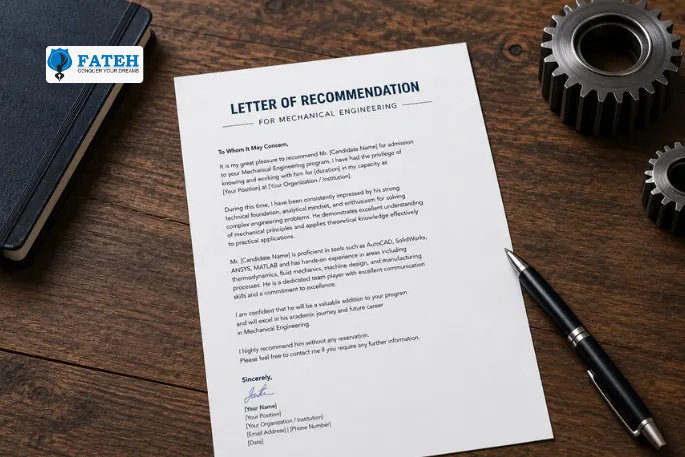
Imagine two students applying to the same university for an MS in Mechanical Engineering, where both have impressive GPAs, relevant internships, and competitive GRE scores. On paper, they appear equally qualified, yet one secures admission while the other does not. Wonder why? Well, oftentimes, the deciding factor is a document that quietly speaks on the applicant’s behalf; a compelling Letter of Recommendation (LOR).
Unlike transcripts or test scores, an LOR tells the story behind your achievements. It gives admissions committees valuable insight into your technical expertise, problem-solving ability, work ethic, and potential to succeed in a rigorous engineering programme. Whether written by a professor, Head of Department (HOD), project supervisor, or employer, a well-crafted recommendation adds credibility to your application by highlighting qualities that grades alone cannot.
For mechanical engineering students, where innovation, analytical thinking, and practical application are highly valued, a strong recommendation can make a significant difference. This guide explains everything you need to know about writing or requesting a letter of recommendation for masters in mechanical engineering, including the ideal format, key components, expert tips, common mistakes, and LOR samples for mechanical engineering.
What Is a Letter of Recommendation for Mechanical Engineering?
Universities usually request two or three recommendation letters as part of the admission process for graduate engineering programmes. Depending on the applicant’s background, these recommendations may come from:
- Professors who have taught core mechanical engineering subjects
- Head of Department (HOD)
- Research supervisors
- Internship mentors
- Employers or reporting managers
Ultimately, a persuasive letter of recommendation for MS in Mechanical Engineering reassures admissions committees that the applicant possesses not only the academic capability but also the professional attitude required to thrive in a rigorous engineering programme.
What Makes a Strong Letter of Recommendation for Mechanical Engineering?
Admissions committees read hundreds, sometimes thousands, of recommendation letters every admission cycle. Because of this, generic statements like “hardworking student” or “excellent performer” rarely leave a lasting impression. What distinguishes an outstanding recommendation is its authenticity, specificity, and ability to provide concrete examples.
A strong letter of recommendation for mechanical engineering students should demonstrate qualities that are directly relevant to the discipline rather than relying on vague praise.
Some of the characteristics admissions committees look for include technical competence, problem-solving abilities, research and innovation, teamwork and collaboration, leadership and initiative and personal development.
Letter of Recommendation for Masters in Mechanical Engineering
A letter of recommendation for masters in mechanical engineering plays a pivotal role in postgraduate admissions because it bridges the gap between academic achievements and personal potential.
At the master’s level, universities are not merely evaluating whether an applicant has performed well during undergraduate studies, but they want to assess whether the individual is capable of handling advanced coursework, contributing to research, collaborating on complex engineering projects, and eventually becoming an industry leader or researcher.
An effective recommendation usually addresses:
- Academic performance in core mechanical engineering subjects
- Research aptitude and analytical thinking
- Design and simulation skills
- Laboratory competence
- Engineering software proficiency (such as SolidWorks, ANSYS, AutoCAD, MATLAB or CATIA)
- Final-year project contributions
- Internship or industrial exposure
- Ability to learn independently
- Communication and teamwork
- Motivation for pursuing higher studies
For example, rather than writing:
The student performed well in my class.
A personalised recommendation will sound something like:
During the Design of Machine Elements course, the student independently redesigned an existing transmission assembly to improve efficiency while reducing manufacturing costs. The project demonstrated exceptional analytical thinking and practical application of engineering principles.
Specific observations like these provide admissions committees with tangible evidence of the applicant’s capabilities.
Academic vs Employer Letter of Recommendation for Mechanical Engineering
One of the most common questions applicants face is whether they should obtain recommendations from professors or employers. Well, the answer depends largely on their academic background, work experience, and the university’s admission requirements.
The following comparison highlights the key differences.
| Academic LOR | Employer LOR |
|---|---|
| Written by professors, HODs, project supervisors, or research guides. | Written by managers, team leads or reporting supervisors.
|
Focuses on academic excellence, technical concepts and research potential.
| Highlights workplace performance, technical execution and professional growth. |
| Ideal for fresh graduates and recent engineering students. | Suitable for applicants with one or more years of relevant industry experience. |
| Discusses classroom participation, laboratory work and projects. | Covers practical engineering applications, client work and project delivery. |
Demonstrates readiness for graduate education.
| Demonstrates industry exposure and leadership potential. |
Regarding the letter of recommendation for MS in mechanical engineering, universities prefer at least two drafts, which allows the admissions committees to evaluate both the applicant’s academic preparedness and real-world engineering capabilities.
Letter of Recommendation for Mechanical Engineering Format and Section Flow
- Introduction The recommender introduces themselves by mentioning their designation, institution or organisation, years of experience, and relationship with the applicant.
- Relationship with the Applicant This section explains how long the recommender has known the applicant and in what capacity.
- Academic or Professional Assessment This forms the core of the recommendation, where instead of generic praise, the recommender should discuss the student’s technical strengths, engineering knowledge, research ability and problem solving skills.
- Notable Achievements This section highlights accomplishments that distinguish the applicant from peers. For instance, relevant publications, industrial projects, leadership positions.
- Closing Recommendation The final paragraph summarises the recommender’s confidence in the applicant and strongly endorses them for graduate studies. A compelling conclusion may include statements regarding the applicant’s ability to contribute meaningfully to research, collaborative projects, and future engineering innovation. The letter should conclude with the recommender’s signature, designation, department, institution or organisation, and official contact information, allowing universities to verify the recommendation if required.
Letter of Recommendation for Mechanical Engineering Students
As a mechanical engineering student, you should choose a recommender who truly understands how important it is to highlight your real-time engineering capabilities. Whether it is a capstone project, laboratory research, an independent model/software design, industrial training, or workplace achievements, sharing these details helps create an application that reflects both technical competence and readiness for graduate study. Because in the end, getting a letter of recommendation from someone who has hands on witnessed your journey holds much more credibility than getting it written by someone at a higher designation but limited knowledge of your profile.
Letter of Recommendation for Mechanical Engineering Samples
While every recommendation should be personalised, the following examples illustrate how an academic and professional recommender can effectively present an applicant’s strengths.
Sample LOR for MS in Mechanical Engineering by HOD
To the Admissions Committee,
It is with great pleasure that I recommend Mr. Rahul Sharma for admission to your Master’s programme in Mechanical Engineering. I have known Rahul for over four years in my capacity as the Head of the Department of Mechanical Engineering at ABC Institute of Technology, where I have taught him courses in Thermodynamics, Machine Design, and Manufacturing Processes while also supervising his final-year capstone project.
Throughout his undergraduate studies, Rahul consistently distinguished himself as one of the most inquisitive and technically proficient students in his batch. He possesses a natural ability to understand engineering concepts beyond textbook knowledge and applies them effectively to solve practical problems. One project that particularly stands out involved the design and optimisation of a solar-powered water pumping system for rural applications. Rahul not only contributed to the mechanical design but also performed detailed performance analysis using ANSYS simulations, enabling the team to improve system efficiency while reducing material costs.
Beyond academics, Rahul displayed exceptional teamwork and leadership skills. During departmental technical events, he willingly mentored junior students and coordinated project activities with professionalism. His calm approach to problem-solving and willingness to support peers earned him the respect of both faculty members and classmates.
Rahul’s intellectual curiosity extends beyond the classroom. He frequently approached faculty members with questions related to emerging technologies in sustainable manufacturing, robotics, and computational engineering, reflecting his genuine interest in pursuing advanced studies and research.
Based on my interactions with Rahul over the past four years, I am confident that he possesses the technical aptitude, research potential, discipline, and perseverance necessary to excel in graduate education. I strongly recommend him for admission to your programme without reservation. I am certain that he will contribute positively to your academic community while making the most of every opportunity available.
Should you require any additional information, please feel free to contact me.
Sincerely,
Dr. Amit Verma
Head, Department of Mechanical Engineering
ABC Institute of Technology
Recommendation Letter for Mechanical Engineer from Employer
To the Admissions Committee,
I am delighted to recommend Ms. Neha Kapoor for admission to your Master’s programme in Mechanical Engineering. I have had the opportunity to work closely with Neha for the past three years as her Reporting Manager at XYZ Engineering Solutions, where she serves as a Mechanical Design Engineer.
From the very beginning of her tenure, Neha demonstrated exceptional technical competence and a remarkable willingness to learn. She quickly became an integral part of our product development team, contributing to projects involving industrial automation equipment and precision mechanical assemblies. Her proficiency in CAD software, finite element analysis, and design optimisation helped her design solutions that consistently met performance and quality expectations.
One of Neha’s most notable contributions involved redesigning a conveyor subsystem for one of our manufacturing clients. By carefully evaluating component geometry and material selection, she successfully reduced production costs while simultaneously improving operational reliability. What distinguishes Neha from many young engineers is her collaborative approach. She communicates effectively with cross-functional teams, actively seeks feedback, and remains composed under demanding project deadlines.
Having observed her professional growth over the years, I firmly believe that pursuing a master’s degree will further enhance her capabilities and prepare her for leadership roles in the global engineering industry. I wholeheartedly recommend her for admission and have every confidence that she will excel academically while contributing meaningfully to your university.
Please feel free to contact me should you require any further information.
Sincerely,
Rohit Mehra
Senior Engineering Manager
XYZ Engineering Solutions
Tips for Writing an Effective Letter of Recommendation for Mechanical Engineering
- Personalise Every Recommendation: The most impactful recommendation letters are tailored to the individual applicant. So, instead of relying on a standard template, the recommender should discuss specific interactions, projects, or situations that demonstrate the student’s capabilities.
- Support Claims with Real Examples: Statements such as “the student is hardworking” or “she has excellent technical skills” carry little weight unless they are backed by examples. So, it is always helpful to talk about a successful design project, research contribution, industrial internship, or process improvement initiative that makes the recommendation significantly more convincing.
- Highlight Technical and Soft Skills Equally: Mechanical engineering programmes seek students who are technically competent but also capable of working in teams, communicating ideas effectively, and adapting to complex challenges. An ideal letter of recommendation for MS in Mechanical Engineering should showcase both engineering expertise and interpersonal qualities.
- Maintain a Professional Yet Genuine Tone: An LOR for mechanical engineering should sound sincere rather than overly promotional. Instead, the recommender should provide balanced observations that demonstrate confidence in the applicant’s abilities.
- Align the Recommendation with the Applicant’s Goals: If the applicant is pursuing research-focused programmes, the recommendation should highlight analytical thinking, research aptitude, and intellectual curiosity. If the applicant aims for industry-oriented master’s programmes, discussing internships, product development, manufacturing exposure, or engineering projects becomes more relevant.
- Keep the Letter Clear and Well-Structured: Logical structure with a clear introduction, body, and conclusion ensures the recommendation is easy to read while effectively conveying the applicant’s strengths.
Common Mistakes in a Letter of Recommendation for Mechanical Engineering
Sometimes, even experienced recommenders can make mistakes that reduce the effectiveness of a good recommendation. Let’s look at some of the common errors:
- Using Generic Templates
- Repeating Information from the Resume
- Providing Vague Praise
- Exaggerating Achievements
- Ignoring the Applicant’s Career Aspirations
- Submitting the Letter Without Proofreading
Letter of Recommendation Request Checklist for Mechanical Engineering Applicants
While request a recommendation letter, it is important to give your recommender sufficient time to write a convincing, more personalised recommendation.
Before requesting a letter of recommendation for masters in mechanical engineering, make sure you have completed the following checklist:
- Choose recommenders who know your academic or professional work well.
- Contact them at least four to six weeks before the application deadline.
- Explain why you are applying for the programme and your long-term career goals.
- Share your updated resume or CV.
- Provide your academic transcripts if required.
- Share your Statement of Purpose to help the recommender understand your motivations.
- Mention the universities and programmes you are applying to.
- Highlight projects, internships, research work, or achievements that you would like the recommender to include.
- Inform them about submission deadlines and whether the recommendation needs to be uploaded directly to the university portal.
- Thank your recommender after they submit the letter and keep them informed about your admission outcome.
Conclusion
A thoughtfully written Letter of Recommendation can significantly strengthen an application for graduate studies in mechanical engineering. While academic records, and Statements of Purpose demonstrate what an applicant has achieved, a recommendation letter explains how those achievements were accomplished and why the candidate is prepared for the next stage of their academic journey.
Whether you are requesting a letter of recommendation for masters in mechanical engineering from a professor, seeking a recommendation letter from employer, or referring to LOR samples for mechanical engineering to understand the expected format, authenticity should remain the foundation of every recommendation.
By choosing the right recommender, providing them with the necessary information, and ensuring the recommendation truly reflects your academic strengths, technical expertise, professional growth, and future aspirations, you will be well positioned to make a lasting impression on admissions committees. Always remember, an insightful letter of recommendation for MS in Mechanical Engineering does not simply endorse your application, it reinforces your potential to contribute to the university and succeed in a demanding engineering environment.
FAQs
A letter of recommendation for mechanical engineering highlights an applicant's academic, technical, analytical, and professional abilities for university admissions.
A professor, HOD, supervisor, or employer familiar with your abilities should write your LOR.
It should include the applicant's technical skills, achievements, work ethic, examples, and a strong recommendation.
A recommendation letter should generally be 400–600 words or one page long.
Yes, employers can provide an LOR, especially for applicants with relevant professional experience.