
Quick Answer: Which Format Fits You?
- Familiarity with computers: If you are accustomed to writing by hand or reading longer texts on paper, you might prefer IELTS on paper. If using a keyboard is new to you, it may increase your stress on test day and lead to avoidable errors.
- Unclear handwriting: If you choose IELTS on paper, your handwriting must be clear and legible. If the examiner cannot read what you have written, it may impact your band score. If your handwriting is difficult to read, IELTS on computer might be a better choice.
- Ability to focus: Most IELTS on paper sessions take place in large rooms with many test takers. If you find this distracting, IELTS on computer might be a better choice. It takes place in a smaller room with fewer test takers, and you get headphones for the Listening section, which can help reduce distractions.
Difference Between IELTS on Paper and Computer
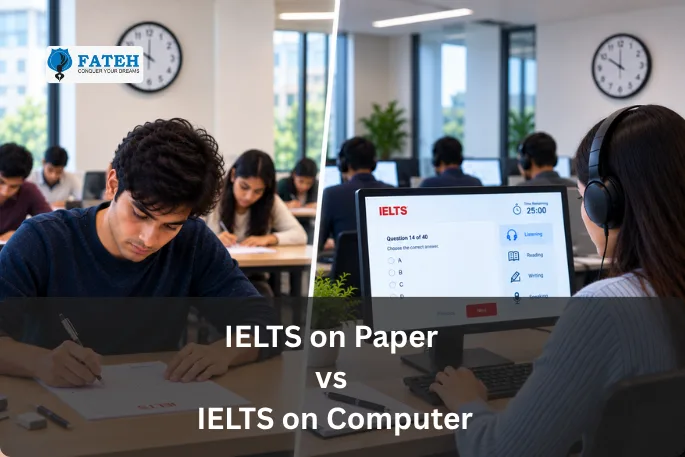
So, which is better IELTS on paper or computer? The important thing to remember when it comes to IELTS on computer vs paper is that IELTS is not easier or harder depending on the format. The questions, scoring and overall test structure are the same. What changes is how you interact with each section. IELTS on computer and paper have the same test structure, scoring, and Speaking format. The main difference is how you complete the Listening, Reading, and Writing sections. Computer-based tests use a screen, keyboard, and headphones, while paper-based tests use printed materials and handwriting. Computer results are also available sooner.
IELTS on Computer vs Paper by Section
| IELTS on Computer | IELTS on Paper | |
|---|---|---|
| Test Format | The test is taken on a computer with headphones and a microphone. | Test taken using a black ball pen and paper. |
| Listening Test | Multiple-choice questions are answered on the computer. | Multiple-choice questions are answered on the answer sheet provided. |
| Reading Test | Texts and questions are displayed on the computer screen. | Texts and questions are presented in a booklet. |
| Writing Test | Typed on the computer using a keypad. | Handwritten on paper using a pen or black ball pen. |
| Speaking Test | Conducted face-to-face with a certified examiner. | Conducted face-to-face with a certified examiner. |
| Result Delivery | Results are available within 2 days | Results delivered within 7 days. |
| Score Reporting | Scores are reported as whole or half bands. | Scores are reported as whole or half bands. |
IELTS Paper Based vs Computer Based: Decision Checklist
| Section | IELTS on Computer | IELTS on Paper |
|---|---|---|
| Listening | Listen through headphones and enter answers directly on screen. | Listen to the recording and write answers on the paper answer sheet. |
| Reading | Read passages on screen and type/select answers. | Read passages on paper and write answers on the answer sheet. |
| Writing | Type both tasks using a keyboard. | Handwrite both tasks. |
| Speaking | Face-to-face with an IELTS examiner. | Face-to-face with an IELTS examiner. |
Myths That Confuse Test Takers
- Myth: The test format is different for IELTS on Paper and IELTS on Computer Truth: Either format, IELTS paper based vs computer based, has the same content, scoring, difficulty level, and sections. These sections include Listening, Reading, Writing, and Speaking. The only difference is that IELTS on Computer uses a computer and keyboard, while IELTS on Paper uses pen and paper.
- Myth: All four sections of IELTS can be completed on a computer Truth: In IELTS on Computer, only Listening, Reading, and Writing are taken on a computer. The Speaking test is conducted face-to-face with a certified examiner.
- Myth: IELTS on Computer is easier than IELTS on Paper, or vice versa Truth: Both formats have the same questions, difficulty level, and content. Neither format is easier. It depends on which format you are more comfortable with.
- Myth: You can take IELTS on Computer anywhere or anytime Truth: IELTS on Computer offers more flexibility, with test dates available up to 7 days a week and 3 times a day. However, you must take the test at a designated test centre and book your preferred date and time in advance.
- Myth: Listening and Reading sections in IELTS on Computer have only MCQs Truth: Be it paper or computer IELTS reading answers, listening answers, both formats have the same types of questions. These are multiple choice, matching, diagram labelling, form completion, note completion, table completion, flow chart completion, summary completion, sentence completion, and short answer questions.
- Myth: IELTS on Computer and IELTS on Paper have the same result timeline Truth: There is not much difference between IELTS on paper and computer. Except the results for IELTS on Computer are available within 2 days after the test, while paper-based IELTS results are announced after 7 days.
- Myth: Candidates have to bring their own system for IELTS on Computer Truth: You do not need to bring your own system. IELTS on Computer is conducted at designated test centres equipped with the required systems. Simply visit your chosen centre on your scheduled date and take the test in a secure environment.
Conclusion
So, are you still deciding between IELTS on paper vs IELTS on computer? Because it ultimately depends on your comfort and test-taking preferences. Both formats have the same content, scoring, difficulty level, and overall structure, with the main difference being how you complete the Listening, Reading, and Writing sections. Consider whether you are more comfortable typing or handwriting, reading on a screen or paper, and working with headphones or in a larger room. IELTS on Computer also offers faster results and greater scheduling flexibility. In the end, whichever format you choose, familiarise yourself with the test format, practise regularly, and select the option that allows you to perform with confidence.
Frequently Asked Questions (FAQs)
Yes. The two formats are different. IELTS on Computer is centre based, while IELTS Online is taken remotely from a private location.
Yes, IELTS on Paper is available for candidates who prefer handwriting and reading printed materials.
Writing is done on a computer for IELTS on Computer and handwritten on paper for IELTS on Paper.
When it comes to IELTS paper vs computer, both formats have the same content, scoring, difficulty level, and test structure.
Yes, IELTS on Computer is accepted by universities, with the same scoring and test structure as IELTS on Paper.