
Introduction
Studying in the UK can be the most thrilling experience of your academic career. It means gaining access to some of the best universities in the world, a long cultural tradition, an interesting social atmosphere, and a qualification recognised all over the world. Without proper preparation, that excitement can disappear quickly.
The UK has a unique way of dealing with activities. Academic standards, social traditions, and even queuing for a bus are different from what international students might know in their home countries.
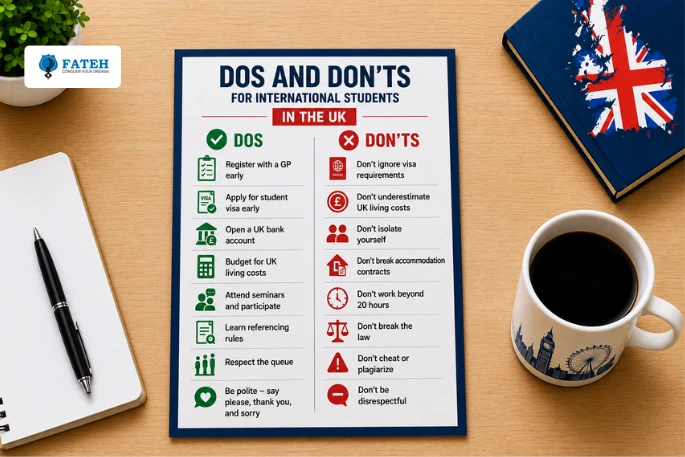
This guide walks you through the most important do and don’t for international students in the UK, so you can hit the ground running instead of spending your first term playing catch-up.
Why Understanding UK Student Life Matters
Each year, more than 600,000 international students opt for studying in the United Kingdom. Many students struggle, not because of their academics, but because they are unfamiliar with how life in the UK works.
Knowing the dos and don’ts for international students in the UK is not about memorising a rulebook. It is about giving yourself the best possible chance to thrive academically, socially, and financially. When you understand what is expected of you, you spend less energy second-guessing yourself and more energy actually living your student life well.
Essential Dos for International Students in the UK
- Register with a GP the Week You Arrive One of the first things you must do after landing in the UK is register with a GP (General Practitioner). Students who pay the Immigration Health Surcharge as part of their visa application can access NHS services after registering with a GP.
Do not wait until you fall ill. GP slots fill up quickly, and the registration process takes a few days to go through. Walk into your nearest GP surgery or university health centre with your passport, visa, and proof of address, and get it done in your first week. You will appreciate having this sorted before you need medical care.
- Apply for Your Student Visa Early and Correctly If you are applying from overseas to the UK, you will need to apply student visa in advance of your course start date. To get the UK Student Visa, you require the CAS number from your university, a document proving your English language proficiency, and financial proof that you can sustain yourself.
Do not underestimate how long this takes. The UKVI recommends applying at least three months before your course begins. Missing the deadline or submitting incomplete documents can delay your entire start date. Meeting all UK visa requirements thoroughly from the outset saves you a great deal of stress.
- Open a UK Bank Account as Soon as Possible It is much easier to pay rent, earn part-time money, and split expenses once you have opened a UK bank account. If you do not have one, you will depend on international transfers, which reduce your finances because of conversion costs and delayed payments.
Major banks such as Barclays, HSBC, Lloyds, and Santander offer dedicated student accounts. You will require your passport, visa, BRP card, a letter from the university, and proof of your address in the UK. Mobile banking apps like Monzo or Starling are also an excellent choice while waiting for your bank account to be activated.
- Budget Honestly for the Real UK Living Cost The UK living cost is quite variable depending on your location. Expenses for students in London range from £1,529 to £2,000 per month. Other towns like Sheffield, Leicester, and Coventry are less expensive, and the cost of living there usually ranges between £1,171 and £1,200 per month.
Make a budget plan before you arrive at university to avoid getting into trouble halfway through the semester. Include rent, food, transport, learning materials, phone expenses, and some money for socialising.
- Attend Seminars and Actively Participate UK universities have a very different academic culture from many other countries. Seminars are not passive listening sessions. Lecturers expect you to have done the reading beforehand, formed your own opinion, and contribute meaningfully to the discussion.
Show up, speak up, and ask questions. Even in your first few weeks, when everything feels unfamiliar, making the effort to engage signals the right kind of student to your tutors.
- Learn Referencing Rules from Day One In UK universities, there are stringent anti-plagiarism rules and policies, and all universities employ plagiarism-detecting software such as Turnitin. UK universities may fail your assignment or expel you for academic dishonesty.
Find out about the referencing style prescribed by your department, which can be either Harvard, APA, or OSCOLA for Law students, and adhere to it from your first assignment onwards.
- Respect the Queue — Always It may seem like a minor issue, but in fact, it is not. In Great Britain, queuing is an aspect of social behaviour. People queue for buses, coffee, supermarket checkouts, and GP appointments. Cutting the queue leads to cold stares and earns disapproving looks or polite reminders.
Always queue at the end of the line, keep your space from the person ahead of you, and wait your turn. It is a small thing that shows great respect for the society around you.
- Say Please, Thank You, and Sorry — Often The British communicate using politeness. You have to say ‘please’ when asking for something, ‘thank you’ when getting the service, and ‘sorry’ when you bump into somebody in a passage by accident.
British people apologise even if it was not their mistake. This is not because they are weak. This is part of everyday British communication. And once you learn to do this, your daily interactions will change for the better.
Important Don'ts to Avoid
- Do Not Ignore Your Visa Requirements UK visa requirements do not become irrelevant right after you land. All international students must follow visa regulations throughout their time abroad, which means attending classes regularly, not working more than allowed, and ensuring that your contact information remains current with your university.
Universities will report all attendance and compliance issues to the UKVI. If you fail to comply with visa conditions and your attendance drops, your visa sponsor will report it, and your visa may be curtailed.
- Do Not Underestimate UK Living Costs Students come with a hazy budget and get into financial trouble in less than three months. You may not be aware of how fast you accumulate expenses on groceries, transportation, and social activities. Budget wisely right from the beginning to avoid major difficulties in the future.
- Do Not Isolate Yourself British people can seem reserved at first. They will not always initiate conversations, and friendships do take longer to form compared to cultures with more outwardly warm social norms. That does not mean you should retreat into your comfort zone.
Join student societies, attend university events, and put yourself in social situations regularly. The connections you build in your first semester often become the network you carry for the rest of your career.
- Do Not Break Accommodation Contracts Without Reading the Terms There will certainly be consequences for leaving student accommodation earlier than expected or without due notice. Before signing a lease, make sure to review its terms, including the notice period, and do not ever pay a deposit without receiving a written receipt.
Student accommodation scams can also happen to international students. Be sure to check that all advertisements are genuine by visiting the official accommodation portal of the university or an authorised letting agent.
- Do Not Work Beyond Your Permitted Hours Most international students on a UK Student Visa can work up to 20 hours per week during term time. Exceeding this limit is a serious visa violation, and the consequences fall entirely on you, not your employer. If a job asks you to work beyond your legal limit, decline clearly and firmly.
Academic Tips for Success in the UK
Start your assignments early. UK universities issue deadlines weeks in advance, and the expectation is that you use that time for genuine research, drafting, and revising, not for producing a first draft the night before.
Visit your tutors during office hours. Most students never do this, which means those who do tend to leave a strong impression. Use those sessions to test your arguments, ask clarifying questions, and get meaningful feedback before the final submission.
Your university library is also far more than a building with books. It gives you access to thousands of academic journals, research databases, and citation management tools. Learn to use it in your first month; it will save you hours every time you write a paper.
Everyday Life in the UK
- Navigating British Social Culture British humour is sarcastic and self-deprecating. They play with each other, but what appears to be an insult is actually a compliment. You should take your time to understand the context in which the insult was made.Respect personal space during conversations. Keep your distance when talking to people and don’t go out of your way to hug those you don’t know.
- Getting Around on Public Transport Trains in the UK are significantly cheaper when booked in advance. If you travel regularly between cities, a 16-25 Railcard gives you a third off most rail fares. In London, use an Oyster card or tap your contactless bank card; cash payments on buses are not accepted in most cities.Plan around peak hours. Travelling between 7 am and 9 am and between 5 pm and 7 pm is noticeably more expensive and more crowded. Off-peak travel is almost always worth the adjustment.
- Dressing for the UK Weather Do not arrive with a summer wardrobe and assume you are sorted. British weather is unpredictable in every season. A warm coat, a waterproof jacket, and a habit of layering are not optional; they are practical necessities. Even in July, a light jacket belongs in your bag.
- Working While Studying in the UK Most international students on a UK Student Visa can work up to 20 hours per week during term time and full-time during official university holidays. This is not just a useful source of income; it is also one of the best ways to build professional experience and improve your English in real-world contexts.Keep clear records of your hours, especially if you hold multiple part-time jobs simultaneously. Popular student jobs include retail, hospitality, tutoring, and campus work. Your university careers service can point you toward legitimate opportunities close to campus, and those roles often come with the added benefit of a flexible schedule that fits around lectures.
First-Month Checklist for International Students
- Collect your BRP (Biometric Residence Permit) from the post office listed in your visa approval letter
- Register with a local GP or university health centre
- Open a UK bank account
- Build a monthly budget covering your full UK living costs
- Apply for a National Insurance number if you plan to work
- Get a 16-25 Railcard and an Oyster card if you are in London
- Attend your university’s international student induction programme
- Join at least two student societies or clubs
- Read your university’s academic integrity and plagiarism policy
- Save your university’s student support helpline in your phone
Common Mistakes International Students Make
- Do not procrastinate visa extension and update: Whatever you want to do, either extend your visa or change your address through UKVI; make sure you finish all your immigration procedures well in advance. Any delay could cause you trouble, and the authorities are seldom willing to provide you with an extension.
- Do not neglect your psychological health: It can be very stressful to go to another country; additionally, academic work can put pressure on you quite soon. However, all UK universities offer counselling and other mental health support services for free.
- Do not isolate yourself because of homesickness: Homesickness is a common problem for international students; however, staying in your accommodation throughout the evenings will make things worse. Be active, get involved in student life.
- Do not confuse British politeness with close friendship: The British people are generally friendly, but real friendship needs time to mature. You can chat politely and enjoy the conversation, but remember the difference between politeness and close friendship, the difference between politeness and intimacy.
- Not checking shop opening hours on Sundays: In smaller UK cities, most supermarkets operate on significantly reduced Sunday hours. Turning up at 7 pm to find the store closed is a completely avoidable frustration; check before you leave home.
FAQs
Focus on these three priorities during your first week: collect your BRP card at the post office, register with GP, and open UK bank account. These steps give you access to healthcare, banking services, and other essential support.
The most common mistakes include neglecting visa requirements, unrealistic budget planning for the cost of living in the United Kingdom, lack of social integration while adjusting, and poor time management in academics. Students who address these areas early generally have a much smoother experience.
Yes, all international students who have been issued with a UK Student Visa are permitted to work for 20 hours per week when the academic year is in progress and full-time when the vacation period begins. Working beyond your permitted hours may breach your visa conditions and lead to serious consequences.
It is not mandatory in law, but in practice it is. Without GP registration, you can't use NHS services and receive prescriptions and referrals to other services. Since the NHS surcharge is one of the visa fees, GP registration becomes a sensible step at once.
Visit any bank branch carrying your passport, student visa, or BRP card, along with your university enrolment letter and evidence of your address in the UK. If you want something quick, digital banks such as Monzo and Starling also offer a quick and convenient option.
The biggest differences involve communication style, social interaction, and everyday etiquette. British communication style is quite indirect. People avoid confrontations and use indirect phrases instead of blunt statements when criticising someone. Building friendships requires more time than in other cultures. Queuing, being on time, respecting personal space, and keeping quiet in public places are musts.