
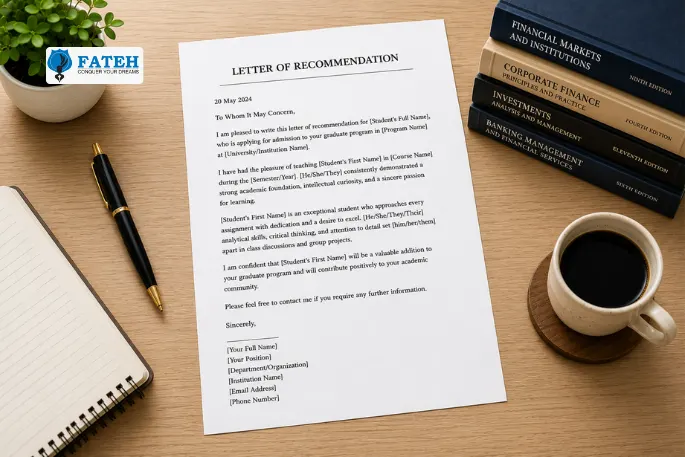
What Is an Academic Letter of Recommendation (LOR)?
A Letter of Recommendation in an academic context, also called an academic LOR, is a formal letter written by someone familiar with your academic performance. In most cases, such a person may be your professor, school teacher, principal, academic advisor, or research supervisor. The main purpose of the letter is to provide universities with information on your capabilities aside from your grades and exam results.
While applying for undergraduate, postgraduate, doctoral, scholarship, or exchange programs, universities require that you present a letter or letters of recommendation. Through such letters, the admission committee will be able to learn more about your academic performance and whether you are capable of thriving at a higher level of education.
Unlike the Statement of Purpose (SOP), which you write yourself, an academic LOR is written from the perspective of another person. This letter is much more credible since it provides an assessment of your qualities from an expert point of view.
Before applying to universities, many students tend to look up academic LOR samples. Reviewing an academic reference letter sample or a LOR sample will enable you to comprehend what a typical structure of the reference letter looks like, its style, and depth of information. Yet, every reference letter has to be unique and tailored to your accomplishments.
What Makes a Strong Academic LOR?
An effective LOR for college is much more than listing positive attributes about you. Admissions counsellors receive hundreds of recommendation letters each year and they are well aware of generic content. A great recommendation letter is the one which can present specific examples that back up everything the letter says about you.
For instance, in lieu of mentioning that you are a hard-working individual, your recommender can mention your work on some research assignment, in which you were able to perform high-quality work within tight time limits. These examples give authenticity to your recommendation letter.
A great recommendation letter must include information which shows that the recommender really knows you. It must include details regarding how long he/she has known you and in what capacity they know you. Moreover, it must provide details of your qualities which qualify you to be part of the program you are applying for. Whatever point is being covered by the recommender, it must help in making a complete picture of you as an academic individual.
Relevance is another key factor. A letter of recommendation that is meant for a master’s degree in engineering is expected to highlight skills related to technical expertise and ability to solve problems while working on projects, while LOR meant for a degree in humanities may be more relevant if it stresses such qualities as communication, critical thinking, and research skills. Personalized LOR is always more helpful than one-size-fits-all recommendations.
Last but not least, a quality LOR is always formatted in line with accepted academic letter of recommendation format.
How to Write an Academic LOR
If you’re wondering how to write LOR application documents or assisting your recommender with a draft, understanding the standard structure can make the process much easier. While every recommendation should be personalized, most academic LORs follow a similar flow.
The letter begins with a formal introduction wherein the recommender identifies themselves and tells why they are recommending the applicant. This part of the document is important because it gives credibility to the recommender by providing information about his/her designation and institution as well as the period he/she has known you. The admission authorities need to know why this particular person’s view should matter to them.
Next comes the performance of the applicant in class. While the recommender will tell about the grades, they should not stop there but give examples of how you did in class, your assignment work, contributions in discussions and in research projects etc.
The second part usually draws attention to your strengths both professionally and academically. These can include your communication skills, analysis skills, leadership skills, ability to work in a team, creativity, research skills, or readiness to learn, depending on which program you apply to. Instead of listing all possible qualities, the writer needs to emphasize those that matter most for your chosen program.
The successful letter must link your previous accomplishments with your future plans. The universities want to know if you are likely to be successful in their program, and therefore, your recommender must provide reasons why he/she thinks that you are ready for the next step in your education process.
Your letter must end with a definitive recommendation. The recommender needs to be confident in your abilities and should have no second thoughts while recommending you. Additionally, your recommender can provide his or her contact information in case the university needs further clarification.
When you are referring to a letter of recommendation template for academics or a letter of recommendation template for students, keep in mind that templates are just there to provide you with the framework of the letter. You need to write a customized recommendation rather than just following the format.
Academic LOR Format and Structure
Focusing on the proper format for an academic letter of recommendation will ensure that the letter you are going to write comes out to be a very professional document with all the information required by the university. While there may be slight variations in the requirement of different colleges, the format of the majority of the academic LOR remains the same.
First of all, you must provide details about yourself such as your name, designation, department, institution, etc. After this, the date and salutation of the letter must be provided. After that, the first paragraph of the letter should start with providing brief information about the writer and his/her relationship with the candidate. You must provide information about the course you took under him/her and the duration of your academic association with him/her.
Recommendation letter’s main body primarily talks about your performance and strengths. It is here that the recommender highlights your class participation, subject expertise, research work, projects, assignments, or any other accomplishments which make you a good candidate. They should not make generic remarks and should back up their remarks through examples wherever possible.
It should conclude the recommendation letter and state that the recommender considers you to be a good candidate for the program. The letter should then end with a proper closing along with the recommender’s signature and designation.
You can easily find that almost all of the academic letters of recommendation templates have this basic pattern. Though the language used in each letter might be different from the other, still the basic format is the same.
Academic LOR Format and Structure
Focusing on the proper format for an academic letter of recommendation will ensure that the letter you are going to write comes out to be a very professional document with all the information required by the university. While there may be slight variations in the requirement of different colleges, the format of the majority of the academic LOR remains the same.
First of all, you must provide details about yourself such as your name, designation, department, institution, etc. After this, the date and salutation of the letter must be provided. After that, the first paragraph of the letter should start with providing brief information about the writer and his/her relationship with the candidate. You must provide information about the course you took under him/her and the duration of your academic association with him/her.
Recommendation letter’s main body primarily talks about your performance and strengths. It is here that the recommender highlights your class participation, subject expertise, research work, projects, assignments, or any other accomplishments which make you a good candidate. They should not make generic remarks and should back up their remarks through examples wherever possible.
It should conclude the recommendation letter and state that the recommender considers you to be a good candidate for the program. The letter should then end with a proper closing along with the recommender’s signature and designation.
You can easily find that almost all of the academic letters of recommendation templates have this basic pattern. Though the language used in each letter might be different from the other, still the basic format is the same.
Academic LOR Samples by Study Level
The content of an academic recommendation changes depending on the level of study you’re applying for. Universities evaluate applicants differently for undergraduate, postgraduate, and doctoral programs, so the recommendation should reflect those expectations.
Here is one successful LOR sample:
Letter of Recommendation
I am pleased to recommend Ms Riddhi Sahani, whom I have known for over four years as a Professor in the Department of Computer Science and Engineering at Manipal University. I taught her courses, including Automata Theory and Compiler Design, IoT Architecture and Its Protocols, and Smart Patient Monitoring Systems, and supervised her academic projects. Among the many undergraduate students I mentor each year, Riddhi consistently stood out for her strong conceptual clarity, analytical ability, and independent approach to learning, which motivates me to recommend her for graduate study.
She demonstrated excellent academic rigour, particularly in theory-intensive subjects. In Automata Theory and Compiler Design, she showed a deep understanding of concepts and applied them logically. She frequently asked insightful questions and contributed meaningfully to classroom discussions, reflecting a strong grasp of fundamentals and clarity of thought.
Her research inclination was evident in her Fake News Detection project, where she independently designed and implemented an end-to-end NLP pipeline. She explored preprocessing techniques, applied TF-IDF–based feature extraction, and evaluated multiple machine learning models. Her systematic refinement of results demonstrated critical thinking and a research-oriented mindset beyond the undergraduate level.
Riddhi is highly disciplined, reliable, and receptive to feedback. In team-based assignments, she often took the initiative to coordinate work and ensure timely completion while maintaining a collaborative environment. Her ability to balance responsibility with teamwork reflects maturity and professionalism essential for advanced academic study.
In conclusion, Ms Sahani is a motivated, capable, and intellectually curious student with strong academic foundations and research potential. I am confident that she will excel in a rigorous graduate programme and contribute positively to her academic community. I offer my strong recommendation for her admission to your esteemed institution.
ABCD
Department of Computer Science and Engineering
How to Request an Academic LOR
Requesting a letter of recommendation is just as essential as that of getting an effective letter. Typically, an effective recommendation letter is written by someone familiar with your academic endeavors and has adequate time to draft the letter.
Do not make your request on the deadline day. Instead, ask for the recommendation letter some weeks ahead of the deadline. Doing this will allow your recommender adequate time to write the letter rather than writing a rushed letter. In asking for the recommendation letter, give reasons as to why you want them to recommend you.
It is always better to provide additional documents like your CV, transcripts, Statement of Purpose, and the list of universities you would like to apply to. In case your professor asks you to come up with a draft, looking at the letter of recommendation sample for student might help you. But do not forget that the letter should reflect your real accomplishments and the opinion of the recommender, not copied information.
After the letter has been sent to the admission committee, do not forget to express your gratitude to your recommender. It shows your professionalism and respect for their efforts.
Common Mistakes in Academic Letters of Recommendation
Sometimes even the most experienced recommender might make some mistakes which will decrease the effect of your academic LOR. One of the most common problems is writing an overly generic letter. If you say that “the student works hard” or “they do well at classes,” it won’t be impressive for the committee unless there are actual examples provided.
Another problem is using a letter, where all the facts are duplicated from your resume or academic transcripts. An LOR should give additional information about your personality, your way of learning and potential in studying rather than just list your accomplishments.
Most of the recommendations become useless because of the lack of personalization regarding the particular course or university. The recommendation for a business course would be useless for an engineering course and vice versa.
The errors in formatting, grammar, and long paragraphs may also impact the readability. Adhering to the format of the letter of recommendation for an academic setting guarantees the clarity and professionalism of the paper. In addition, one should not rely on a letter of recommendation template too much without mentioning personal details. The templates only assist in structuring the recommendation.
Academic LOR Submission Checklist
Prior to sending your recommendation letter, spend a few moments to make sure that everything in your recommendation letter is correct. Double-check to make sure that the name, designation, and institution of the recommender have been included appropriately and the connection between you and the recommender is clearly explained. The letter must contain specific references to your academic achievements rather than any general praises about you.
It is as important to verify whether there are any spelling or grammar mistakes in the document, to make sure that the document meets the requirements of the university, and that it has the signature of the recommender where appropriate.
Conclusion
Academic letter of recommendation is not simply a supporting document; it is an opportunity for educational institutions to assess your potential through the lens of the person who has been mentoring you during the whole academic path. The good quality recommendation will enhance your application emphasizing your skills, accomplishments and readiness to continue studies.
While preparing applications, one may get acquainted with some samples of academic LOR, an academic reference letter sample or LOR example. Nonetheless, the best recommendations are always individual and reflect real-life experience. If you have to use an academic letter of recommendation format, academic reference letter format or LOR application documents examples, remember that the most important aspect is the truthfulness of your recommendation letter.
FAQs
An academic LOR (Letter of Recommendation) is a letter written by a teacher or professor explaining a student’s academic skills, achievements, and abilities.
It can be written by professors, lecturers, project guides, or faculty members who know the student and their academic performance.
An academic LOR is usually one page long and should include important details about the student’s academic journey and skills.
It should include the student’s academic performance, strengths, achievements, projects, skills, and the recommender’s opinion about the student.
Yes, a Head of Department can write an academic LOR if they are familiar with the student’s academic performance and achievements.
Most universities ask for 2–3 academic LORs, but the number may differ depending on the university and course.