
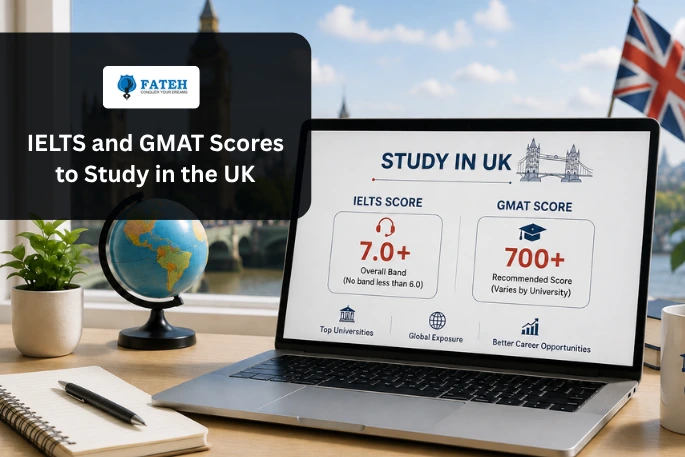
IELTS and GMAT Requirements for Studying in the UK: An Overview
International English Language Testing System (IELTS) has been designed to assist students and professionals from non-native English-speaking countries in presenting their language proficiency. Whether the intention is to study or work in an English-speaking country.
IELTS offers two formats: academic, for study or professional purposes, and general training, for migration or below-degree-level study. Additionally, candidates have the option to choose between the paper-based or computer-based IELTS exam. The exam comprises four components: speaking (11–14 minutes), writing (60 minutes with two tasks), reading (60 minutes), and listening (around 30 minutes with 40 questions).
The IELTS test is accepted by universities and UKVI as proof of English proficiency. The test is mostly taken in person at an official test centre and ielts exam dates depends on whether you are taking a computer-based or paper-based test. Most of the universities in the UK accept IELTS, but the band requirement varies by programme and institution. They have specified the overall and component vise band on their entry requirement page. However, the university must be a licensed student sponsor. The ielts exam fee is 19,000 presently.
The possibility of waiver is based on the Grade 12 English scores or the submission of a Medium of Instruction (MOI) letter, subject to the university’s admission policy.
The GMAT (Graduate Management Admission Test) is purpose-built for business education and has been trusted by management programmes since 1953. Specifically designed to measure advanced reasoning, data literacy and problem-solving abilities, the GMAT signals a candidate’s readiness to tackle the quantitative and analytical rigour of MBA and business master’s courses. Top business schools and even leading employers in sectors like consulting and finance often consider a strong GMAT score as a mark of genius and business acumen.
However, this is not a mandatory requirement for admission in the UK universities. The criteria for admission differ from one institution to another. Mostly, the entry requirements are based on academic records, subject studied and overall student profile. Certain universities may put the GMAT test as a requirement for their MBA courses. Some of these globally recognised universities are the University of Edinburgh, University of Manchester, City St George’s, University of London, Cranfield University, and the University of Warwick.
IELTS Score Requirements for UK Universities
The base or the minimum IELTS requirement for undergraduate course application is 6 overall, with no less than 5.5 Band in all the components. Further, if the target is a postgraduate course, the minimum band is 6.5 overall.
It is to be noted that the requirement for IELTS score to study in UK varies from university to university and course to course. For instance, QMUL has defined their band requirement as per the different schools, their School of Art requires Band 5 and the School of Biological and Behavioral Sciences overall 6.
The differentiation of course can also reflect in band requirements; for more communicative, creative and research-based courses, an overall band of 7 is needed.
GMAT Requirements for UK Universities
The most prestigious UK business schools—including London Business School, University of Cambridge, University of Oxford, Imperial College London and Warwick Business School accept both for MBA and specialised business master’s programmes. The GMAT is often viewed as the benchmark exam for business school applicants due to its business-specific focus and perceived rigour in quantitative and analytical skills.
Competitive GMAT score requirements for the top UK programmes usually range between 650 and 710, with London Business School and Cambridge expecting scores near the higher end.
Mid-tier and emerging business schools may accept lower GMAT scores (around 550-600) or equivalent GRE scores. They typically consider overall application strength, including work experience and academic records.
The following UK universities specifically ask for a GMAT score for their MBA program:
- City St. George University of London
- University of Manchester
- University of Edinburgh
- University of Warwick
- Cranfield University
- University College London
Can You Study in the UK Without IELTS or GMAT?
Simply, yes, there are multiple ways of getting an IELTS waiver, and a majority of the UK universities offer the same. One of the most common criteria for availing a waiver is a distinction score in 12th standard English. One is expected to have 60%-70% in 12th English from Central boards and 75%-85% from the state boards. Another measure is a Medium of Instruction Letter, which should specify that you have studied in English and not in any regional language.
GMAT is not a mandatory requirement in the UK; having this does present your credibility, but if you do not have it, you can still apply to all the major courses available in the UK. However, universities like UCL, Cranfield, and the University of Manchester require GMAT for their MBA programs.
Some institutions offer GMAT waivers based on extensive professional experience or previous academic performance, aligning with the trend towards flexible admissions policies. In terms of GMAT exam dates there is no fixed annual calendar, the exam is available year-round.
English Language Test Alternatives Accepted by UK Universities
IELTS although the most renowned, but still not the only English Proficiency test; UK universities also accept TOEFL, PTE and Duolingo. The overall score requirement also varies, and you would need to refer to particular course page to understand which tests are accepted by the university and the expectations around the overall score.
Other than that, universities sometimes themselves conduct English Tests. For instance, BrunELT by Brunel University of London and SWELT by Swansea University, which are alternative of IELTS for the respective universities.
How to Meet UK Admission Requirements
Admission requirements depend on the chosen course and university, but more generally, to apply for an undergraduate programme you would need to complete your schooling, having scored well in all the critical subjects. Further, for a postgraduate degree, you must have completed your bachelor’s degree.
If we further go by the research-oriented Russell Group universities and establish Plate-glass universities, the minimum requirement revolves around 75 to 90% for their UG programmes and 60 to 70% for their PG programmes.
Some of the modern universities may accept a lesser score, depending on the overall profile and experience of the student. However, 60% is the minimum for UG applicants and 55% can be accepted for their PG courses.
In term of English Language requirement, most of the times for the IELTS requirements for UK the band is listed on the university website and course page. How one can apply for a waiver and if their grade 12th score matches the minimum requirement should be verified first. If the medium of instruction has been English during academic years than a certificate stating the same should be taken from the university referring to the same.
Other than that, before making the application, accumulate all the required academic, professional, and identification documents. You would also need to submit a Statement of Purpose to show your intent; draft the same as per the targeted course and university and do research.
With every document in place and clear intentions, make your application.
How to Choose Between IELTS, PTE, TOEFL, and GMAT
IELTS is a more common exam and is accepted by almost all UK universities, but this does not mean the other tests are not accepted or recognised by the universities.
In comparison with PTE, both IELTS and PTE test the same four skills: reading, writing, listening, and speaking. The difference is in how they test you and how fast you get your results.
Someone who has appeared for PTE will get faster results. PTE typically delivers scores within 48 hours, sometimes sooner. If you are working to a deadline, this matters. Further, if your comfort lies in a more structured approach and computer-based environment, and you tend to do well in timed, systematic tasks, then PTE rewards accuracy and consistency.
In terms of TOEFL, the test is accepted and preferred worldwide by more than 12,000 institutions. One of the most beneficial aspects is that students can choose where and how to write the test – from the comfort of their home or at the test centre. It also offers quick registration and test scheduling along with easy payment options. The total testing time is less than 2 hours, and students can even check their unofficial reading and listening scores at the end of the test.
Duolingo is also an adaptive test that you can attempt from the comfort of your home; a quiet room suffices. Overall, it takes 60 minutes, is more affordable and provides a quick turnaround.
So, while choosing a test, its important to understand what works in your favour, how soon do you need the results and what simplifies the overall process for you. The without IELTS universities in UK is a possibility
Finally, GMAT is not an admission requirement for UK universities except for MBA, and that too for a few universities.
Common Mistakes Students Make
Some of the most common mistakes that a student tends to make are as follows:
- There is a minimum component requirement, alongside the overall Band stated on the university page; ignoring the same can lead to rejection of your application.
- Note that every English exam results, including IELTs are only valid for two years, so you can not submit an expired test score.
- Even when you intend to submit MOI, certain UK universities does not accept the same from a few specific boards. So, its necessary to verify if your school board is accepted or not.
- Always follow university application deadlines; make a note of the same.
Conclusion
The universities want to understand if you have the acumen to study their academic programmes and grow in a competitive environment, so they choose candidates as per their scores, test results and overall background. To present that you can communicate in English and would be able to study in an environment where the native language is different from your domestic language, IELTS is required; the possibility of waiver stands with it. Similarly, GMAT also presents your credibility for business courses, and there is no harm in testing your skills by means of the same, even if it is not a mandatory requirement.
FAQs
No, there are other ways to show your English proficiency as well to ger admission in UK universities without IELTS.
The score requirement depends on the course and university.
The GMAT remains the gold standard for MBA admissions, especially at elite UK institutions, due to its business-focused structure and reputation for rigour in quantitative and analytical skills. Its scores often carry significant weight in scholarship and recruitment processes within the business sector.
Yes, by availing an IELTS waiver, you can study in the UK, but first you have to check the exact course and university requirements.
Although most UK universities does not mention the same as a mandatory requirement, some of the examples are Durham University Business School, Lancaster University Management School, University of Birmingham and various others.
Yes, PTE is accepted by various acclaimed universities.