
What Is a Letter of Recommendation for Electrical Engineering?
The LOR for MS in Electrical Engineering is a letter that is written by someone who either taught you, supervised you, or worked alongside you, such as a professor or manager. An LOR is used to evaluate your skills and potential in regard to your future in the engineering field or as a graduate student. Compared to resumes and SOPs which are written in your own voice, an LOR is based on how someone else views you.
What Makes a Strong Letter of Recommendation for Electrical Engineering
A strong LOR isn’t about fancy words. It’s about specifics. The best letters talk about:
- An important project or a class that you excelled in.
- A specific instance when you dealt with a technical issue or debugging problem.
- Your comprehension of major topics in electrical engineering, such as circuits, power systems, signal processing, etc.
- Your accomplishments as a team player and the way you convey information.
Who Should Write Your Letter of Recommendation for Electrical Engineering
Most universities ask for 2-3 LORs, and a good mix usually looks like this:
- A professor should have taught you at least one important engineering subject or oversaw your project.
- A research supervisor, if you have undertaken research work.
- A manager, if you have prior engineering experience.
Do not choose someone solely based on their title. A department head who hardly knows you exists will be able to deliver nothing but a generic and meaningless letter. A professor who supervised your final year project and is able to refer to your contributions will write a much better recommendation letter.
LOR for MS in Electrical Engineering Requirements
There is a great degree of similarity in the EE programmes of popular countries such as Britain, Ireland, Dubai, or New Zealand. A standard LOR for MS in Electrical Engineering is a formal document ideally limited to one page. Typically, it includes the recommender’s contact information, information on the relationship between them and the applicant, examples that substantiate the applicant’s strengths, and a strong closing statement.
Letter of Recommendation for Electrical Engineering Format
Below is the LOR for electrical engineering format:
- Header – recommender’s name, title, institution, and contact details
- Opening – how long and in what capacity they’ve known you
- Body paragraph 1 – your academic or technical strengths, backed by an example
- Body paragraph 2 – a specific project, achievement, or challenge you handled well
- Body paragraph 3 – your personal qualities: teamwork, communication, leadership
- Closing – a clear, confident recommendation, plus an offer to provide more information if needed
- Signature – name, designation, and date
Most letters run one page. Anything much longer starts losing the reader’s attention.
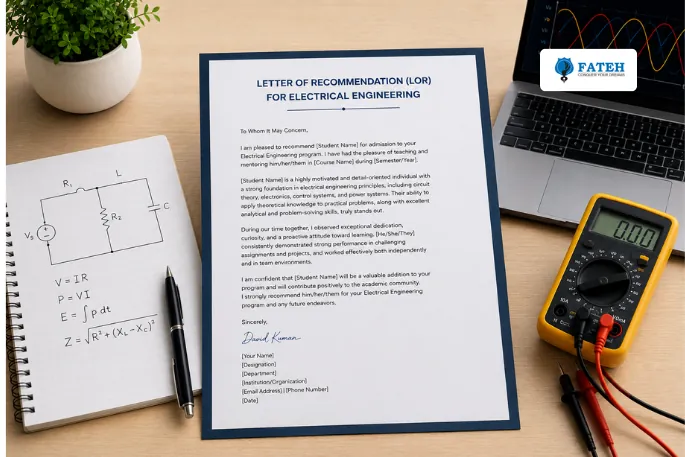
Sample Letter of Recommendation for Electrical Engineering
While multiple LOR samples for MS in Electrical Engineering may follow different formats and styles, the LOR for Electrical Engineering example below provides a clear reference.
LETTER OF RECOMMENDATION
To Whom It May Concern,
I am pleased to recommend (applicant’s name) for admission to the Master’s programme in Electrical Engineering at your esteemed university. As a faculty member and department head, I have had the opportunity to observe the applicant’s academic performance, technical abilities, research interests, and extracurricular contributions throughout their undergraduate studies.
They have maintained a strong academic record and has demonstrated a solid understanding of fundamental engineering principles. They have shown particular interest in areas such as electrical systems, embedded technologies, signal processing, control systems, and related interdisciplinary fields. Their ability to apply theoretical concepts to practical engineering challenges reflects their analytical skills and readiness for advanced graduate-level study.
(Applicant’s name) possesses proficiency in engineering and design tools commonly used in the field, along with programming knowledge that supports their interest in computational and technology-driven applications. Their willingness to continuously learn new software platforms and technical methodologies highlights their adaptability and commitment to developing the skills required for research-oriented work.
As part of their undergraduate project work, the applicant has demonstrated innovation and technical curiosity by working on a project involving the development of an intelligent engineering solution using modern sensing, computational, and embedded technologies. The project reflects their ability to understand complex systems, collaborate effectively with team members, and apply engineering knowledge to solve real-world problems.
Beyond academics, the applicant has actively participated in student organisations and technical clubs, contributing creative ideas and demonstrating leadership abilities. Through their involvement in planning and executing technical events, coordinating teams, and managing responsibilities, they have developed strong communication, organisational, and teamwork skills.
I strongly recommend the applicant for admission to your distinguished programme. I am confident that they will contribute positively to your academic community and make meaningful progress in their chosen field.
Sincerely,
[Recommender’s Name]
[Designation]
[Department Name]
[University/Institution Name]
[Contact Information]
Electrical Engineering Achievements to Highlight in an LOR
Not everything needs to be a research paper. Some solid things worth mentioning:
- Final year or capstone projects (circuit design, embedded systems, power electronics, etc.)
- Published papers or conference presentations
- Internships or industry training
- Competitions
- Coding or simulation skills – MATLAB, Simulink, PSpice, VHDL
- Any certifications or technical workshops attended
The goal is to pick 1-2 achievements and go deep, rather than listing everything shallowly.
Tips for Writing an Effective Letter of Recommendation for Electrical Engineering
- Share your resume, personal statement, and institution names with your recommender to help them tailor their recommendation.
- Make sure you ask for a recommendation as early as you can for them to have time to write a proper one.
- Provide specific examples that they can use in their recommendation but let them know that they are free to add in whatever they want.
- Make sure that the tone of the letter is sincere. It is easy to spot an exaggerated recommendation, and it might harm your candidacy.
- Make sure you proofread for mistakes in grammar and formatting.
Common LOR Mistakes in Electrical Engineering Applications
- Choosing a recommender based solely on their title instead of their knowledge of your work
- Being vague in positive remarks without providing examples
- Using identical letters for multiple applications without checking for specificity
- Letters which speak of your grades but not of your character and work habits
A Simple Recommender Checklist for an Electrical Engineering LOR
- Your latest CV that includes details of your education, work experience, volunteering, and other relevant skills.
- A personal statement or an insight into your aspirations so that the letter of recommendation will match your application.
- A list of universities and programmes you’re applying to, along with any specific LOR requirements.
- Important achievements like final-year project, research projects and conferences, and other necessary qualifications.
- Information about your work, including projects, assignments, or occasions where you proved your teamwork and/or leadership capabilities.
- Submission instructions and deadlines, including whether the university requires an online submission or a signed PDF.
- Sufficient time for writing the letter, preferably about 3-4 weeks in advance of the deadline.
Conclusion
An LOR for electrical engineering can actually determine how the admissions team perceives your application as a whole. It does not matter how impressive the title of the person is; what matters is the ability to discuss specific things from the professional experience of the applicant. Pick the right references and give them everything they need to write a solid letter.
If you’re not sure how to approach this, or want help structuring your entire application, it’s worth talking to people who do this every day. Come talk to Fateh Education. Whether you’re aiming for the UK, Ireland, Dubai, or New Zealand, we can help you put together an application that actually stands out.
FAQs
It's a formal letter, usually written by a professor or supervisor, that vouches for your technical skills, academic performance, and character for your MS in Electrical Engineering application.
Ideally a professor who taught or supervised you, a research/lab supervisor, or a manager if you have relevant work experience, someone who knows your actual work, not just your name.
Specific examples of your technical work, a project or challenge you handled well, your core EE skills, and your personal qualities like teamwork and communication.
Usually 300-500 words, or about one page. Universities often specify an exact limit, so it's worth checking each portal.
Things like circuit design, power systems, embedded systems, signal processing, and tools like MATLAB, Simulink, or VHDL, depending on your specialization.
The core letter can stay largely the same, but always check each university's specific format, word count, and submission requirements before sending it in.