
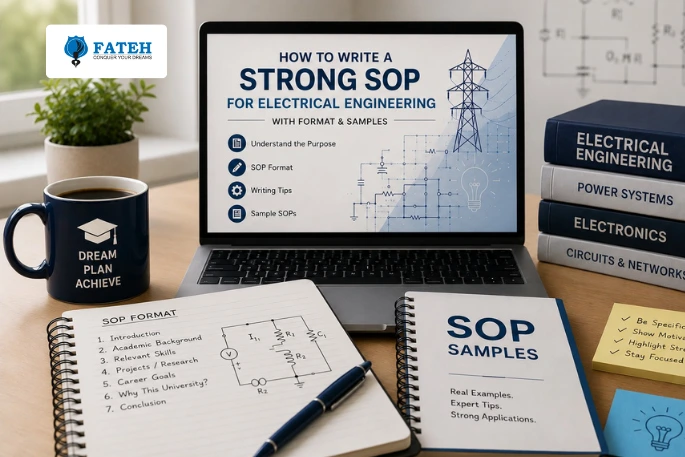
What Is an SOP for Electrical Engineering?
A Statement of Purpose for Electrical Engineering talks about your aspirations for studying Electrical Engineering. It reveals everything about your interest in Electrical Engineering to the admissions officers. In fact, it is your opportunity to explain why you selected this discipline of engineering, what led you to this direction and what your ambitions are. This is one of the most significant parts of your application since it is something more than just numbers that describe your academic background but an essay that has to be full of passion and enthusiasm about the course.
This same approach applies if you’re writing an SOP for Masters in Electrical and Computer Engineering, since ECE programmes expect the same clarity of purpose, just with added emphasis on the computing side of the field.
What an SOP for Electrical Engineering Must Prove
Your SOP is not just a story about your life. It has a job to do. It needs to prove a few things to the admissions committee.
To begin with, the Statement of Purpose for Electrical Engineering must clarify why you chose the field of Electrical Engineering rather than some other engineering branch. What made you become interested in circuits, signals, and/or electrical power systems.
Second, it should prove you actually know what you’re getting into. Talk about the projects you’ve done, the concepts you’ve studied, or the problems you’ve tried to solve. This shows you’re not choosing this field just because it sounds good.
You must also connect your past experience with future goals. Mention how the subjects you studied during your undergraduate degree made you want to continue your education with a master’s degree.
Finally, it is very important to provide a reason why you are suitable for the university you chose. Talk about the professors, researches, labs, or modules that appeal to you the most.
SOP for MS in Electrical Engineering Structure and Format
A good, uncomplicated format is the most effective. Here’s how to structure it:
- Introduction – Start with what originally drew you to your interest in Electrical Engineering. You can share a short personal story, a project or an event that made you interested in this field.
- Academic Background – Share your experience of undergraduate studies. Make sure to mention important subjects, projects or any research conducted by you that led to your passion for a certain field.
- Work experience or projects – If you have worked or done internships, share that experience in this section, including what you learnt and how it helped you decide to pursue further studies.
- Why this programme – Inform the admissions committee why you chose this particular university. Be sure to mention academic faculty, research labs or modules related to your field of interest. Being specific is of utmost importance in this section.
- Future goals – Tell the committee what you wish to do after you complete your degree. It can be research, employment or even starting a new business. Just make sure that it is an obvious follow up to everything that you wrote above.
- Conclusion – End your statement on a confident note. Be sure to reiterate your interest and readiness for the programme.
How to Write a Statement of Purpose for Electrical Engineering
Writing an SOP may appear difficult at first, but it becomes simpler once you divide it into smaller steps.
- First, you should make a list. Write down your motivation for choosing the field of Electrical Engineering, the most significant academic moments in your career, the projects and internships you have done so far, and your future goals. Write down your thoughts without the concern about the phrasing at this stage.
- The next step is to create an appropriate introduction. The opening will be your hook for a reader. You may want to reflect on the project that impressed you or a real-life situation that awakened your interest in electrical systems rather than saying something like “I have always been interested in machines.”
- The next thing to do is to build your story step-by-step. Start from your background, proceed to the projects and work experience you have, and continue with the reasons for pursuing this particular programme and your future plans. Follow the logical flow of the content so that the reader can easily follow your life story.
- Edit your SOP two or three times. Get rid of any redundant information, fix grammar, and ensure that each paragraph conveys something important about you.
Tips for Writing a Strong SOP for Electrical Engineering
The following tips can help you write a compelling SOP for Electrical Engineering that stands out.
- Get down to the specifics rather than talking in general. Give the name of the project that made you interested in technology rather than just saying, “I am fond of technology.”
- Show, don’t just tell. Anyone can use the words “I am a hardworking person.” But instead, one should describe the situation where one’s hard work helped to solve the issue.
- Keep your sentences short and clear. Long, complicated sentences create unnecessary difficulties in reading SOPs. Simple language sounds more confident.
- Avoid reiterating the resume. In an SOP, one has to explain one’s achievements rather than restate them.
- Make sure you have researched the university thoroughly. Use the names of professors, labs, or modules, as this indicates that it is not another recycled Statement of Purpose for Electrical Engineering sent to different institutions.
- Follow the word limit.
- Seek feedback prior to submitting your SOP. Ask someone with certain experience to help you with your paper.
- Proofread carefully. Small spelling or grammar mistakes can create a bad impression, even if your content is strong.
SOP for Electrical Engineering Samples by Applicant Type
This structure also works if you’re writing an SOP for MS in Electrical Engineering for universities abroad like the UK, Ireland, Dubai, and New Zealand. Below is a sample SOP for MS in Electrical Engineering.
During the first year of my engineering course, I created a simple circuit that allowed a bulb to turn on and off using a sensor instead of a switch. Although it was a minor project, the way in which the current reacted to something as ordinary as light or touch fascinated me. That single study drove an enthusiasm for knowing more about electrical systems on a deeper level, which led me to take up my Bachelor’s degree in Electrical Engineering at [University]. Since then, I’ve tried to build on that curiosity through my coursework and my time as a [Job Title/Intern Role], where I got to apply what I learned to real problems. However, it showed me that this is just the beginning in this domain. Hence, I want to pursue a Master’s degree in Electrical Engineering at your university.
I took subjects as part of my undergraduate degree programme that focused on Digital Electronics, Analog Systems, Electronic Circuits, Control Systems, Signal Processing, and Power Systems. None of these subjects appealed to me as much as the practical work done in the laboratory. By doing hands-on work with circuits, sensors, and basic control systems, I learned more than just theories taught in the classroom.
My final year project involved working with a team and designing an automatic water level detector and motor controller. I took an active role in all phases of this project from concept to building the circuit and testing the final product. While working on this project, I learned important life lessons along with the technical knowledge gathered during this project.
I undertook an internship at [Company Name] as part of my degree, where I worked on the practical cases of electrical and electronic systems. My work included testing and validating circuit designs while researching different communication modules for smart devices. One of the projects I worked on was aimed at building a system capable of tracking and optimising processes in real-time. Witnessing how theoretical concepts become practical solutions confirmed my decision to continue pursuing the same field through further education.
Along with my studies, I completed courses that included studying programming and using circuit simulation tools, which gave me a strong technical base.
Upon graduation, I worked as a [Job Title] at [Company Name], where, among my projects, was the creation and testing of electrical systems in applied situations. This position not only enabled me to see theoretical problem-solving put into practice but also revealed the gaps in my advanced technological knowledge. Being confronted with obstacles at work solidified my desire for greater depth of knowledge that is necessary for my progress in this area, hence my choice of a Master’s degree in Electrical Engineering.
My choice of place for pursuing this degree is [Country] due to its well-established reputation in the field of knowledge and its focus on practical learning. The rapid growth of technological and engineering industries in the country will also enable me to establish useful connections.
While researching universities, I found that the Master’s in Electrical Engineering at [University Name] fits my goals perfectly. The course structure, with its strong focus on practical application alongside core technical concepts, is exactly what I am looking for. I am particularly interested in the work of [Professor Name], whose research in [specific area, e.g., power systems/renewable energy/VLSI] aligns closely with my own interests. The access to modern labs and facilities at your university gives me confidence that I will be well-prepared to handle the evolving challenges of this field.
After completing my Master’s, I plan to work in the [specific sector, e.g., renewable energy / R&D] sector, contributing to the development of efficient and sustainable electrical systems. I hope to combine my technical expertise with real-world impact, and I believe this programme will give me the right foundation to do that.
I would be grateful for the opportunity to study at your university and contribute meaningfully to its academic community.
Thank you for considering my application.
While these electrical engineering SOP samples provide useful guidance, make sure your final SOP reflects your own experiences instead of copying any template.
Common SOP for Electrical Engineering Mistakes to Avoid
- Beginning your SOP with a cliché. Statements like “I’ve been interested in engineering since I was a kid” are commonly used by thousands of applicants. Admission officers read such statements on a daily basis, so you should try to do better and start with something about your own personal experience.
- Being too vague about the university. If you can take a paragraph and replace the name of the university and it would still make sense, then it is a sign that you haven’t thought enough about your choice. Mention specific professors, modules, or laboratories that had an influence on your choice.
- Just retelling your resume. Your SOP shouldn’t be merely a summary of your past achievements. It should explain what you had to study and learn in the course of this important journey.
- Using too much jargon. Some applicants try to sound smart by using complicated terms. However, a good SOP should be written in plain language, not as a technical manual.
- Writing pages and pages without focusing on important facts. To write a successful SOP, you should know the word limit well and formulate your thoughts accordingly.
Final SOP for Electrical Engineering Submission Checklist
- Does your opening avoid cliches and feel specific to you?
- Have you clearly explained why you chose Electrical Engineering?
- Does your SOP mention specific projects, coursework, or work experience?
- Have you explained why you chose this particular university and country?
- Are your future goals clearly connected to your past experience?
- Is your SOP within the word limit?
- Have you removed any generic or copy-paste lines?
- Have you proofread for spelling and grammar mistakes?
- Has someone else reviewed it for feedback?
- Does it sound like you, and not like a template?
If you can tick off all of these, your SOP is likely in good shape to submit.
Conclusion
Drafting an SOP for Electrical Engineering or a statement of purpose for Electrical Engineering isn’t difficult when you focus on your genuine experiences. Reviewing a sample SOP for Electrical Engineering can help you understand the expected structure, but your final document should always be original.
It’s just a way to express yourself: the reasons why you chose this field, what you find interesting, and what you plan to do in the future. Instead of trying to impress people, focus more on being truthful and detail-oriented. Make sure that your enthusiasm for the field is clear. With an effective structure and relevant style, your SOP is sure to impress.
Need help writing your SOP for the UK, Ireland, Dubai, or New Zealand? Get expert guidance from Fateh Education
FAQs
An SOP, or Statement of Purpose, is an essay you submit with your university application. It explains why you want to study Electrical Engineering, what your background looks like, and what your future goals are.
Start with a specific moment or experience that got you interested in Electrical Engineering. Then talk about your academics, projects, or work experience, followed by why you chose that particular university, and end with your future career goals.
Most universities expect an SOP between 800-1000 words, so 1200 words can be slightly long. That said, always check the specific word limit mentioned by the university you're applying to, since some do allow a bit more flexibility.
You can reuse the overall structure and content, but you should always customise the part where you talk about why you chose that specific university.
If your GATE score is strong and relevant to the programme you're applying for, you can mention it briefly, usually alongside your academic background.