
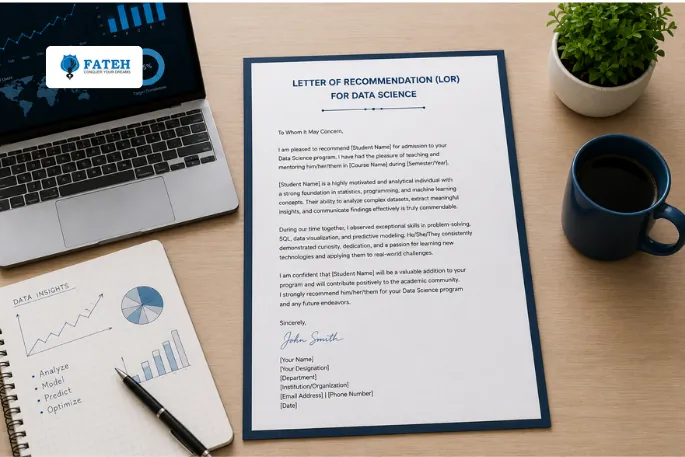
What Is a Letter of Recommendation for Data Science?
A Letter of Recommendation for Data Science is a formal endorsement that offers admission committees an independent evaluation of your qualifications, characteristics, and suitability for the programme you have chosen to study. Unlike your Statement of Purpose, an LOR for data science brings insights from someone who has closely observed your academic and professional performance, rather than simply reflecting your own perspective.
More importantly, especially for Data Science programmes, recommenders generally emphasise your quantitative aptitude, programming capabilities, analytical mindset, your ability to solve real-world problems, and how you handle or work with large datasets. Additionally, since Data Science combines mathematics, statistics, computer science, and knowledge of emerging technologies such as Artificial Intelligence and Machine Learning, admission committees often appreciate recommendations that demonstrate both technical competence and practical problem-solving abilities.
Therefore, a well-written LOR for master’s in Data Science allows universities to not only understand what you have achieved but also helps them comprehend your ability to contribute to research, classroom discussions, and collaborative projects.
What a Strong LOR for Data Science Must Prove
A strong/effective LOR should convince the admission committee that you possess both the academic foundation and personal qualities required to excel in the Data Science programme. Hence, rather than simply listing achievements, your LOR for Data Science should support each claim with concrete examples to enhance your suitability for the programme.
To write a strong LOR, one should demonstrate:
- Strong analytical mindset, logical reasoning, and problem-solving and critical thinking abilities
- Proficiency in subjects like mathematics, statistics, or quantitative analysis, along with technical expertise in programming languages such as Python, R, SQL, or Java
- Experience working with large datasets, data visualisation, or predictive models
- Teamwork and communication skills during academic or professional projects
- Ability to manage complex assignments and meet deadlines
- Ethical handling of data and attention to detail
Also keep in mind that the most persuasive recommendations demonstrate these qualities through classroom performance, capstone projects, internships, research work, or industry experience.
Who Should Write Your LOR for a Master's in Data Science
To write a Letter of Recommendation for Master’s in Data Science, your recommender should be someone who has supervised your work and can provide meaningful insights into your academic and professional journey through concrete examples. Notably, the credibility of a recommendation depends highly on who writes it; therefore, it becomes necessary to choose your recommenders wisely.
Suitable recommenders include:
Academic Recommenders:
- Your LOR for Data Science can be written by your professor or department head, who has taught you Data Structures, Machine Learning, Statistics, Database Systems, Mathematics, Artificial Intelligence, or related subjects.
- Academic recommendations are generally required for recent graduates, who are directly applying after their bachelor’s degree.
Professional Recommenders:
- Applicants with work experience may obtain recommendations from an immediate manager, team leader, or project manager.
- Professional LORs are especially valuable when they endorse real-world problem-solving, data-driven decision-making, and technical contributions with clear evidence.
LOR for MS in Data Science Format and Structure
Although most universities rarely define any specific format for a Letter of Recommendation for MS in Data Science programmes, most effective Data Science LORs follow a clear format, which includes-
Introduction:
The recommender should start by introducing themselves, their designation, institution or organisation, and their relationship to the applicant by explaining the duration of acquaintance, courses taught or project supervised, or nature of academic or professional interaction.
Academic and Technical Evaluation:
Afterwards, the recommender should discuss the applicant’s analytical thinking, technical knowledge, programming abilities, research skills, and problem-solving skills through specific/concrete examples to strengthen the recommendations.
Personal Qualities:
The recommender, then, should discuss qualities such as leadership, communication, teamwork, curiosity, and time management through specific projects, teamwork, and collaborations.
Overall, the letter should conclude by expressing confidence in the applicant’s ability to succeed in a Master’s in Data Science programme and provide contact information for verification if required.
How to Prepare for a Strong LOR for Data Science
Although writing the LOR is in the hands of the recommender, applicants can make sure to help them write informed and personalised recommendations. Before requesting an LOR for Data Science, try to provide your updated resume, academic transcripts, Statement of Purpose (if available), list of projects, internship details, research publications, certifications or practical training, awards or achievements, and university details for a personalised note on your journey. You can also discuss your career goals so that they align the recommendation with your future aspirations without exaggerating your achievements.
More importantly, always request your recommendation well in advance to give them sufficient time to prepare your endorsement letter.
Sample LOR for MS in Data Science
Let us now try to understand how to write an effective LOR through a Sample Letter of Recommendation for MS in Data Science.
Sample Letter of Recommendation
To whomsoever it may concern,
It is a pleasure to recommend XYZ, whom I have had the opportunity to teach and mentor at (the name of the institute) in courses such as Machine Learning with Python, Programming in C, and Data Structures and Algorithms. Over this period, I have observed his academic growth, technical competence, and dedication to learning, all of which make him a strong candidate for advanced academic pursuits.
During his academic tenure, XYZ has maintained an excellent academic record, achieving a CGPA of ABC in his Bachelor of Computer Applications. He possesses a strong foundation in programming languages, including Python, Java, C, C++, and SQL, along with practical exposure to tools and frameworks such as Flask, Pandas, NumPy, and Scikit-learn. His understanding of data preprocessing, feature engineering, and data visualisation reflects a well-rounded grasp of both theoretical and applied aspects of computing.
What distinguishes Mr XYZ is his ability to translate knowledge into meaningful applications. His project, “1st Project Name”, demonstrates his capability to work with real-time data, apply analytical techniques such as technical indicators, and present insights through interactive visualisations using Plotly. This project highlights not only technical proficiency but also his ability to approach complex problems in a structured and insightful manner.
Additionally, his “2nd Project Name” showcases an understanding of recommendation techniques such as TF-IDF and cosine similarity, along with his ability to integrate APIs and databases like MySQL into functional systems. XYZ’s work on an “3rd Project Name” further reflects his attention to security, scalability, and user-centric design, while another chatbot project illustrates his interest in building interactive applications.
Beyond academics, XYZ is a proactive and well-rounded individual. His involvement as a Graphic Designer and member of the Photography Society demonstrates creativity and strong visual communication skills. Furthermore, his participation in community service initiatives, including volunteering with NGOs and contributing to social welfare activities, reflects a sense of responsibility and empathy.
In the classroom, Mr XYZ is attentive, inquisitive, and consistently engaged. He is receptive to feedback and demonstrates a willingness to improve, which is essential for continuous growth. His ability to work both independently and collaboratively further adds to his strengths and acumen.
In my opinion, XYZ possesses the intellectual capability, technical skills, and determination required to succeed in a rigorous academic environment. He has a genuine interest in data-driven problem-solving and a strong motivation to advance his knowledge in this field.
I strongly recommend XYZ without reservation and am confident that he will continue to excel in his future academic and professional endeavours. Please feel free to connect with me at the email address………….. if you have any questions regarding his profile.
Sincerely,
XYZ
Tips for Writing an Effective LOR for Data Science
The key to writing an effective and impactful LOR for Data Science is to make it personal and evidence-based. Keep in mind that the admissions committee values authenticity more than overtly enthusiastic language.
Some of the best practices and tips to write an effective LOR include:
- Use specific examples instead of generic praise and highlight measurable achievements whenever possible.
- Discuss technical and interpersonal skills together, while equally focusing on qualities relevant to Data Science.
- Maintain a professional and objective tone and avoid exaggeration or unrealistic claims.
- Keep the recommendation concise, typically between 400 and 500 words.
- Tailor the content in a way that best reflects the applicant’s academic or professional background.
Together, these tips will make your endorsement letter stand out to the admission committee, enhancing your chance of acceptance to the chosen university.
Common LOR Mistakes in Data Science Applications
As we have already mentioned tips to write an effective LOR, let us also discuss common mistakes that silently reduce the credibility of your document.
Some of the most common mistakes for LORs in Data Science include:
- Using identical LORs for every applicant
- Writing generic praise without supporting examples, including exaggerated claims that cannot be verified
- Repeating information already available in the resume
- Focusing only on grades while ignoring technical abilities
- Mentioning irrelevant personal information and using informal language
- Submitting incomplete or unsigned letters
In the end, note that a genuine, personalised recommendation is always more persuasive than a highly embellished one.
LOR Submission and Authenticity Checks for Data Science Applications
Universities generally require recommendation letters to be submitted through their online application portals or sent directly by the recommender via an official institutional or company email address.
In some cases, admissions offices may conduct authenticity checks to verify the credibility of submitted recommendations. These checks can include confirming the recommender’s designation, institutional affiliation, official email address, or contacting them for additional clarification if necessary. For this reason, applicants should never draft misleading recommendations or submit fabricated letters.
Conclusion
To sum up, it can be clearly said that a Letter of Recommendation is one of the most crucial and influential documents while pursuing a Master’s programme in Data Science, as it offers a third-person perspective on the applicant’s academic and professional capabilities. A strong LOR is one that goes beyond praising the candidate and focuses on providing concrete evidence of the applicant’s analytical thinking, technical competence, research aptitude, collaboration, and problem-solving skills, linking these skills with the suitability of the upcoming programme. Lastly, by selecting the right recommender, providing relevant supporting documents, and ensuring the endorsement letter remains authentic and personalised, applicants can significantly strengthen their chances of securing admission to the leading Data Science programmes across the globe.
FAQs
A Letter of Recommendation (LOR) for Data Science is a formal endorsement that offers admission committees an independent evaluation of your qualifications, characteristics, and suitability for the programme you have chosen to study.
For a Master’s in Data Science, your recommender should be someone who has supervised your work and can provide meaningful insights into your academic and professional journey through concrete examples.
An LOR should convince the admission committee that you possess both the academic foundation and personal qualities required to excel in the Data Science programme. A strong LOR goes beyond praising the candidate and focuses on providing concrete evidence of the applicant’s analytical thinking, technical competence, research aptitude, collaboration, and problem-solving skills, linking these skills with the suitability of the upcoming programme.
Yes, it is acceptable if your recommender is not from the Data Science field. Since most universities do not require Data Science-specific recommenders, what matters most is that the recommender has closely supervised your academic or professional work and can provide a credible evaluation of your abilities.
Yes, in most cases, you can use the same Letter of Recommendation (LOR) for multiple universities, provided it is not addressed to a specific institution. Many applicants submit the same recommendation to several universities, especially when applying to similar Data Science programmes.
However, if a university has specific prompts, evaluation questions, or formatting requirements, your recommender should tailor the letter accordingly.
Yes, applicants with work experience may obtain recommendations from an immediate manager, team leader, or project manager.