
Introduction
Choosing the right university is similar to navigating through a dense forest; your choice will determine your future path, and the environment can significantly impact your journey. UK universities blend traditional heritage with cutting-edge research, placing them among the world’s best with a rich history, innovative spirit, and global recognition. Many students view a degree from a UK university as a valuable asset.In this blog, we’ll discuss what makes the top 10 UK universitiesthe gems of higher education. The dynamic academic scene of the United Kingdom welcomes you regardless of your aspirations—that of a future business leader, aspiring engineer, or developing artist.
What Is a Letter of Recommendation for Biotechnology?
Let’s first understand what is a LOR for Biotechnology? Basically, it is a formal letter written by someone who knows you professionally or academically, like a professor, teacher, manager, or supervisor. This person vouches for your overall skills, character, and achievements, and their word carries great influence because it comes from someone who has observed your work. For biotechnology applicants specifically, an LOR for Biotechnology is typically needed for university or college admissions, especially for programmes abroad in the UK, US, Canada, Ireland, and Australia, along with scholarship applications, job applications in research or industry roles, and visa applications, where it can support the credibility of your work or study plans.
What Makes a Strong LOR for Biotechnology Programmes?
A strong Letter of Recommendation for Biotechnology goes beyond listing a student’s positive qualities. It should explain why the applicant stands out by highlighting real examples from their academic, research, or laboratory experience. For example, instead of simply saying ‘Riya is a hardworking student’, a professor could describe how she led a research project, solved a challenge in the lab, or made a valuable contribution to an experiment. These details make the recommendation much more credible and memorable.
At the same time, who writes the letter matters just as much as what they write. A research supervisor or lab mentor who has worked closely with the applicant can offer far more meaningful insights than someone who only knows them from classroom lectures. It also adds credibility when the recommender compares the applicant with their peers, such as describing them in the LOR for Biotechnology sample as ‘one of the top three students I have mentored in the past five years’. This gives the admissions committee a clear standard to go through the student’s potential.
Lastly, the recommendation should reflect the type of biotechnology course the student is applying for. A research-focused programme should highlight laboratory skills, analytical thinking, and research aptitude, while an industry-oriented course should emphasise teamwork, communication, and practical problem-solving. Above all, the letter should feel genuine and personal, using authentic examples that showcase the applicant’s strengths and growth instead of relying on generic praise.
Who Should Write Your LOR for Biotechnology?
The quality of your recommendation depends not only on what is written but also on who writes it. Your LOR should come from someone who knows you well and has seen your skills and growth firsthand. For biotechnology applicants, this is usually a professor, research supervisor, lab mentor, or internship manager who has closely worked with you and can confidently talk about your academic abilities, research experience, and overall potential.
That said, it is advised to avoid picking someone based purely on their seniority or title. A well-known professor who barely remembers you will end up writing a weaker letter than a junior researcher who supervised your day-to-day responsibilities.
How to Prepare for a Strong LOR for Biotechnology?
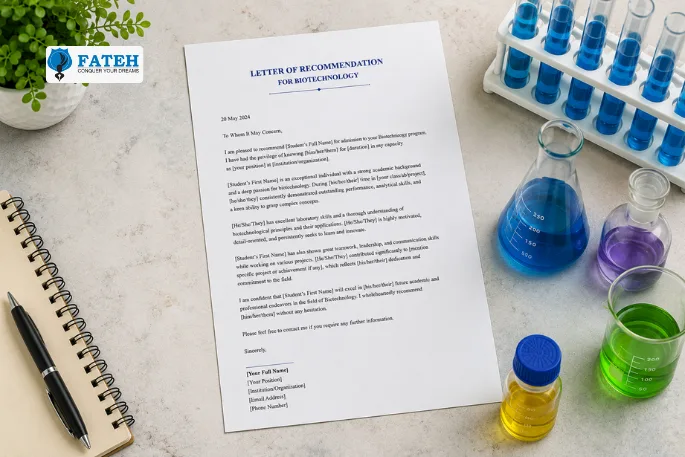
LOR Format for Biotechnology Programmes
- Header – Start with the recommender’s name, designation, institution or organisation, and contact details. Ideally, the letter should be printed on the official letterhead.
- Salutation – Address the letter to the Admissions Committee or a specific admissions officer, if their name has been given.
- Introduction – Start by introducing the recommender and explaining their relationship with the applicant. This section should briefly mention how long they have known the applicant and in what academic or professional capacity.
- Body Paragraphs – Highlight the applicant’s strengths with specific examples of academic performance, research experience, technical skills, problem-solving abilities, or professional contributions. Ensure to support claims with relevant instances that show the applicant’s potential.
- Conclusion – Towards the end, summarise the recommender’s overall assessment and provide a confident endorsement of the applicant. It is also common to mention that they are willing to provide further information if required.
- Signature – Conclude the letter with the recommender’s full name, designation, institution or organisation, and contact details.
LOR Samples for MS in Biotechnology
Let’s have a look at the LOR Samples for MS in Biotechnology as how they are written:
Professional LOR for an MS in Biotechnology
To the Admissions Committee,
It is my pleasure to write this letter of recommendation for Anand Sharma, who is applying to your MS in Biotechnology programme. I have worked closely with him for the past two years as his manager at Gene Core Life Sciences, where he was part of our research and development team focused on cell culture optimisation and bioprocess improvement.
From early on, he stood out for his ability to take ownership of complex problems without needing much guidance. When our team faced recurring contamination issues in one of our bioreactor batches, he took the initiative to trace the root cause himself and proposed a revised sterilisation protocol that reduced contamination rates by close to 30 percent. This kind of independent thinking is not something we typically see from someone at his experience level, and it placed him among the top two performers on a team of fifteen.
Beyond his technical strengths, Anand communicates clearly, documents his work meticulously, and collaborates well across departments, qualities that matter just as much in research setting as raw technical skill. He is genuinely curious about the science behind his work, often reading up on recent developments in molecular biology on his own time and bringing fresh ideas into team discussions. His colleagues respect him not just for his output but for how dependable he is under pressure.
I have supervised several interns and analysts over the years, and he ranks among the most capable I have worked with. He has consistently shown the discipline, curiosity, and problem-solving ability needed to thrive in a demanding academic environment, and I am confident he will bring the same rigour and dedication to your programme that he has shown here.
I recommend Anand Sharma without reservation and am happy to provide any further information if needed.
Warm regards,
Academic LOR for MS in Biotechnology
To the Admissions Committee,
I am writing to recommend Akansha Sethi for admission to your MS in Biotechnology programme. I have known her for the past three years, first as a student in my Molecular Biology course and later as a research assistant in my lab, where she worked on a project studying gene expression in stress-tolerant crop varieties.
Akansha has consistently been one of the strongest students I have taught in over a decade, both in the classroom and in the lab. During her final year, she led a small research project examining drought-resistance markers in wheat, and her careful, methodical approach to data collection resulted in findings that we later included in a departmental research paper. Her ability to design experiments independently, interpret results critically, and troubleshoot unexpected outcomes places her among the top three students I have mentored in the last five years.
What stands out most about her, beyond her academic ability, is her genuine curiosity and her willingness to help her peers understand difficult concepts. She often stayed back after lab sessions to walk juniors through techniques she had already mastered, without ever being asked to. This combination of technical strength and generosity toward others is rare, and it speaks to the kind of collaborative researcher she will become.
Academically, she graduated among the top of her class, and her coursework in genetics and cell biology reflects both a strong theoretical foundation and a genuine interest in applying that knowledge practically. She has the analytical mindset, patience, and research discipline that a graduate programme demands, and I am confident she will make a meaningful contribution to your department.
I recommend Akansha wholeheartedly and would be happy to provide any further information if needed.
Sincerely,
LOR Differences for BSc, MS and Research Biotechnology Applications
Once you have understood the LOR for Biotechnology sample, meanwhile it is also important to note that expectations for the letter depend on the level of study you’re applying for.
For a BSc in biotechnology, the letter tends to lean on academic performance, curiosity, and how well the student understands the basics of subjects like biology and chemistry. Majority of the applicants at this stage haven’t had much experience to research yet, so these letters usually come from schoolteachers or academic advisors who’ve watched them grow in the classroom settings.
Furthermore, once you get to an MS in biotechnology, the focus shifts. It’s less about general academic ability and more about coursework, hands on lab experience, and any research or internship work picked up during the undergraduate years. Naturally, these letters tend to come from professors or lab supervisors who can speak on whether the applicant is all set to take on something more advanced.
Lastly, for research heavy programmes, think PhD or a research-based MS, the letter really needs to lean into independent thinking, how the applicant handles problems in the lab, and their ability to design and run experiments without a lot of hand holding. These letters usually come from research supervisors who’ve worked closely with the applicant for a good stretch of time, and they tend to carry the most weight when it comes to the final decision.
Biotechnology Achievements to highlight in a Letter of Recommendation
Important tips for Writing an Effective Biotechnology Recommendation Letter
A few simple habits can make a noticeable difference in the quality of the letter. Firstly, you should begin with a strong opening that clearly shows the recommender’s relationship with the applicant. Incorporate real-life examples throughout instead of relying on adjectives alone. Whenever possible, include a specific number or measurable result, since intricate details are far more convincing than vague praise. Besides, keep the tone conversational and natural rather than overly formal or stiff, and make sure the letter is tailored specifically to biotechnology rather than reading like a generic template that could apply to any field. At the end, conclude document with a confident and direct approval.
Common LOR Mistakes in Biotechnology Applications
- Avoid using generic statements like hardworking or passionate without supporting them with real-time examples from the applicant’s academic, research, or laboratory experience.
- Choose a recommender who has worked closely with the applicant and can write about their strengths with confidence and credibility.
- Balance personal qualities with academic achievements, technical skills, and research capabilities instead of focusing only on personality traits.
- Write a detailed recommendation that provides better insights rather than a short letter that feels rushed or incomplete.
- Tailor the content to the biotechnology course by highlighting the skills and experiences that are most relevant to the programme.
- Carefully proofread the letter to avoid errors in names, dates, or formatting, and ensure it sounds genuine instead of reading like a generic template.
Following these simple points can help create a recommendation letter that is authentic and relevant.
LOR Submission Checklist for Biotechnology Applications
Before you submit your LOR, make sure to run through this quick checklist as followed:
- Always double-check the recommender’s name, title, and contact details are correct
- Check whether the university or programme name is accurate throughout
- Make sure the letter is on official letterhead, if required
- Ensure the letter length falls within the expected range, usually one page
- Confirm submission method, whether it’s a portal upload, physical copy or email
- Double-check the deadline and give your recommender plenty of time
- Finally, send a polite thank-you note once the letter has been submitted successfully
In conclusion, a well-written LOR for Biotechnology can enhance your application by presenting your skills, research potential, and achievements through credible, real-life examples. By choosing the right recommender, following the correct format, and personalising the content, you can submit a recommendation letter that leaves a memorable impression to the admissions committee.
FAQs on Letter of Recommendation (LOR) for Biotechnology: Samples, Format and Writing
Almost all tier-1 universities offering MS, PhD, and research-based biotechnology programmes in countries like the UK, the US, and Ireland, require one or more LORs as part of the application.
An LOR for Biotechnology should highlight the applicant's academic or professional strengths, research skills, achievements, and potential through specific examples, ending with a clear recommendation.
Yes. Most universities prefer LORs on an official institutional or company letterhead, along with the recommender's designation and contact details.
An LOR for Biotechnology format should ideally be one page long, or approximately 400-500 words.
Yes, although tailoring the letter to a specific university or programme is recommended whenever possible.
An LOR for Biotechnology format should ideally be one page long, or approximately 400-500 wordsMost universities require two to three LORs, usually from professors, research supervisors, or employers.